

Contents
Key takeaways
- A credit score reflects repayment history and credit use. It does not measure whether this month’s income covers this month’s bills.
- In an Equifax Canada / Leger survey (October 2026), 19% of Canadian adults said they have a strong credit score but are struggling to cover expenses (25% in households with children under 18).
- When the score is fine but cash is tight, check bill timing against paydays, separate essentials gaps from revolving debt, cut high-cost shortfalls first, and rebuild a small cushion.
- Borrowing can bridge a one-off cost when the rest of the budget works. It is not a fix for a month that is short every time.
You pay your bills on time. Your credit score looks healthy. And somehow, by the third week of the month, the account is thin again.
That mix is more common than it feels. In a November 2026 Equifax Canada survey with Leger, nearly one in five Canadian adults (19%) said they have a strong credit score but are struggling to cover their expenses. Among households with children under 18, that rose to 25%. The survey asked 1,525 adults from October 9 to 11, 2026.
A credit score is useful. It is just answering a different question than the one your bank balance asks every payday.
What a credit score actually measures
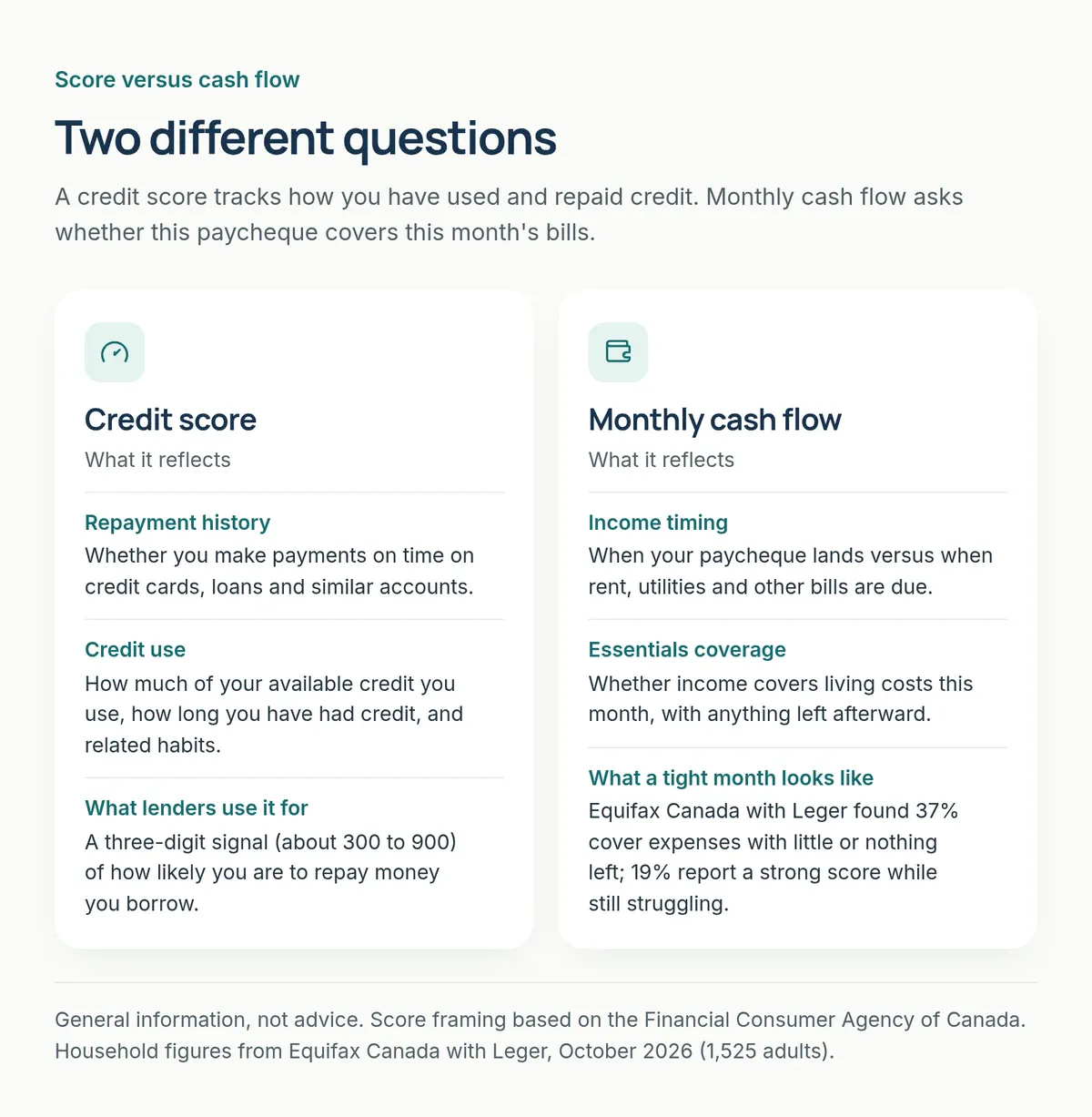
According to the Financial Consumer Agency of Canada (FCAC), your credit report is a summary of how you have used credit in the past: accounts, balances, and whether you make payments on time. Your credit score is a three-digit number drawn from that report. It shows how likely you are to repay money you borrow. Scores usually run from about 300 to 900, and a higher number is better.
What that number does not measure is whether this month’s income covers rent, groceries, transit and childcare. You can keep every minimum payment current, stay under your limits, and still have almost nothing left after essentials. The score looks at repayment history and credit use. Your paycheque has to cover living costs on a schedule that rarely matches those signals.
Why a good score and a tight month can coexist
The same Equifax Canada / Leger survey found that 39% of respondents can cover expenses comfortably with money left over, while another 37% can cover expenses but have little or nothing remaining. Fifteen percent sometimes or regularly use credit or borrow to cover essential expenses, rising to 21% among adults aged 18 to 34 and among households with children.
In other words, a large share of people are getting through the month with almost no cushion, and a smaller but meaningful group is leaning on credit for basics. Neither pattern shows up cleanly as a “bad score” if the card payments themselves stay on time.
A separate Ipsos survey for the 2026 IG Financial Confidence Index (2,000 Canadian adults, August 11 to 25, 2026) found that 58% would need to borrow money or draw on savings to handle an unexpected $2,000 expense. That combines two different responses, so it is not the same as saying most people would have to borrow. It still shows how thin the margin can be on paper.
What to check when the score is fine but cash is short
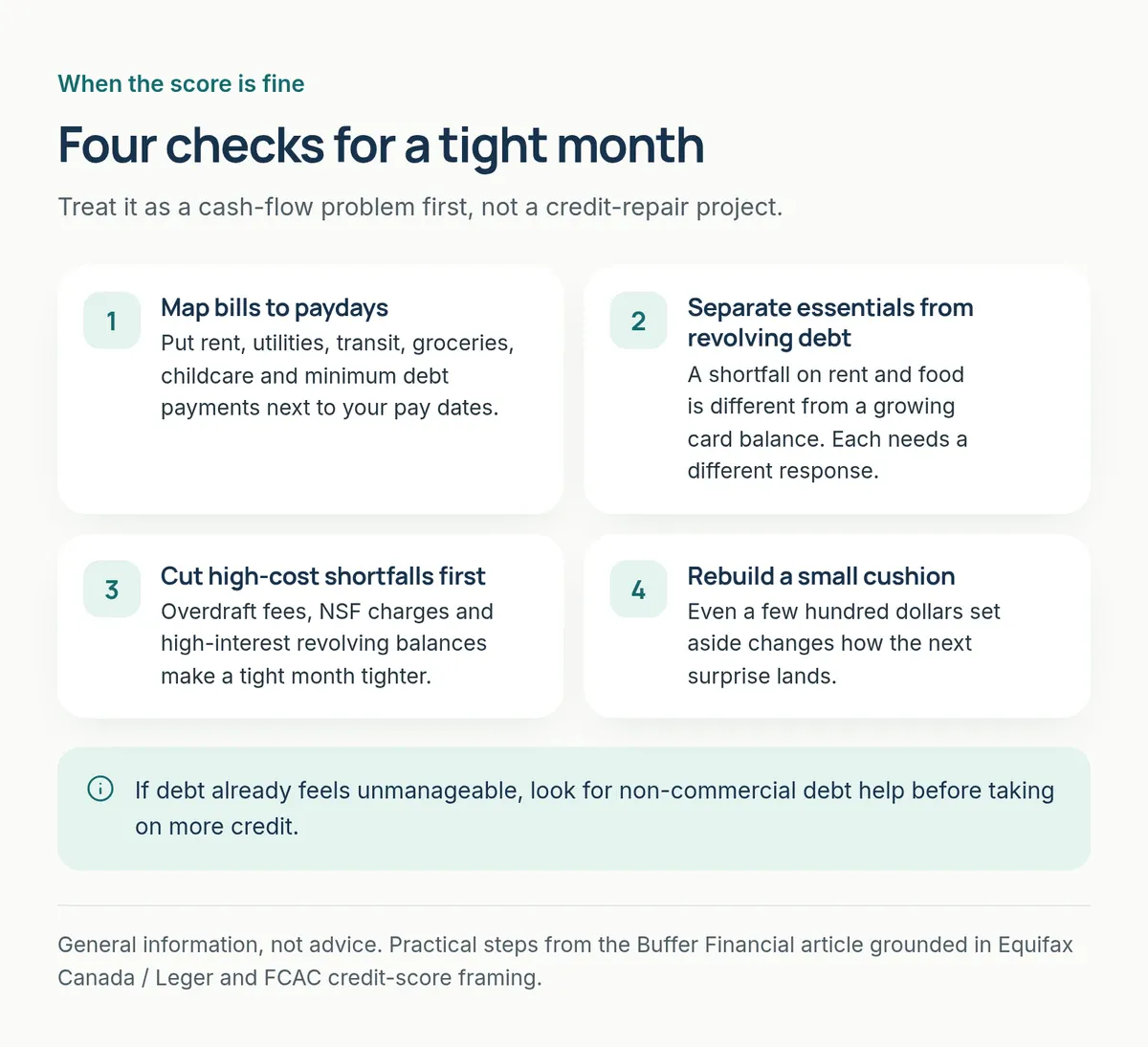
If this sounds familiar, treat it as a cash-flow problem first, not a credit-repair project. A short practical pass:
- Map bills against paydays. Put rent or mortgage, utilities, transit, groceries, childcare and minimum debt payments on a calendar next to your pay dates. Many “short every month” stretches are timing mismatches: a big bill lands mid-cycle while income arrives later.
- Separate an essentials gap from revolving debt. A shortfall on rent and food is different from a growing card balance. A one-time gap and a pattern of rolling debt need different responses; see Will a small loan fix my money problem?
- Cut the highest-cost shortfalls first. Overdraft fees, NSF charges and high-interest revolving balances make a tight month tighter. Avoiding those leaks often frees more cash than polishing an already solid score.
- Rebuild a small cushion on purpose. Even a few hundred dollars set aside changes how the next surprise lands. If your paycheque already feels spoken for, start with a tiny automatic transfer; see How do I start an emergency fund when my paycheque is spoken for?
Hypothetical example. Say take-home pay is $2,400 twice a month, rent is $1,900 on the first, and transit plus groceries run about $700. Cards show on-time payments and a strong score. On paper you look reliable to a lender. In the account, most of the first paycheque is already spoken for, so a car repair mid-month still forces a hard choice. The score did its job. It never claimed to measure leftover cash.
When borrowing helps, and when it does not
Borrowing can bridge a one-off cost when the rest of the budget works. It does not fix a month that is short every time, and stacking new credit on an essentials gap usually makes the next month harder. If debt already feels unmanageable, start with non-commercial help; How do I find debt help in Canada without getting ripped off? covers how to tell counsellors, licensed insolvency trustees and paid advisors apart.
If your workplace offers Buffer, it is a small personal loan benefit for eligible employees, typically $100 to $1,500 over 1 to 6 months at 12% to 18% APR. Underwriting looks at employment, income and bank transaction history, not only a traditional credit score, and there is no hard credit inquiry. Approval is not guaranteed, and borrowing creates a repayment obligation. See What will a small loan cost me?, What does no hard credit check actually mean? and What is Buffer and how does it work?
A good credit score is worth protecting. It just is not a monthly budget. If you are short most months despite a healthy score, the useful work is in timing, essentials versus revolving debt, high-cost leaks and a small cushion, not in chasing another point on the report.
This article is general information, not financial, credit or legal advice. Buffer is not affiliated with or endorsed by Equifax Canada, Leger, Ipsos, IG Wealth Management or the Financial Consumer Agency of Canada.
Questions and answers
Can I have a good credit score and still be short every month?
Yes. Equifax Canada with Leger found that 19% of Canadian adults surveyed in October 2026 said they have a strong credit score but are struggling to cover expenses. A score tracks how you have used and repaid credit, not whether income covers living costs.
What does a credit score measure, according to FCAC?
The Financial Consumer Agency of Canada says your credit score is a three-digit number from your credit report that shows how likely you are to repay money you borrow. Your credit report summarizes accounts, balances and whether you make payments on time. It is not a monthly budget check.
What should I do first if my score is fine but cash is tight?
Treat it as a cash-flow problem first. Map bills against paydays, separate an essentials gap from revolving debt, cut high-cost shortfalls such as NSF or overdraft fees, and start rebuilding a small cushion. If debt already feels unmanageable, look for non-commercial debt help before taking on more credit.
Does Buffer only look at my credit score?
No. Buffer underwriting considers employment, income and bank transaction history, not only a traditional credit score, and there is no hard credit inquiry. Approval is not guaranteed, and borrowing creates a repayment obligation.
Loans are subject to eligibility and approval. Typical loan amounts are $100–$1,500, with 1–6 month repayment terms and 12%–18% APR. No interest is charged if an eligible employee repays in full within the one-time 29-day repayment period. Borrowing creates a repayment obligation.
Sources and references
- Nearly half of young adults surveyed worry their financial health could affect major financial milestones · Equifax Canada (with Leger)
- 2026 IG Financial Confidence Index: Confidence remains stable amid differing financial realities · Ipsos Canada (commissioned by IG Wealth Management)
- Credit report and score basics · Financial Consumer Agency of Canada
Product facts in this article were supplied by Buffer Financial Inc. This article is general information, not personal financial advice or an offer of credit.