

Contents
Key takeaways
- Earned wage access lets employees draw pay they’ve already earned before payday. The amount is generally deducted at the next payroll.
- That suits short timing gaps, but the next paycheque is smaller by the amount drawn and any fees, which can leave the following pay period short.
- A structured small loan works differently: the next paycheque arrives in full, but instalments are still a repayment obligation over a set term, and approval isn’t guaranteed.
- According to an employment lawyer quoted by Human Resources Director, Canada has no specific laws or regulation for EWA yet. Deduction rules vary by province, so check with a qualified adviser.
- Before offering either model, ask about access limits, employee fees, payroll deductions, data flows and what happens when someone leaves.
If you’re looking at earned wage access, you’ve probably heard the pitch already. Employees get paid for hours they’ve already worked, before payday, and the program often costs the company little or nothing. It’s worth taking seriously. Plenty of people run short a few days before payday, and the Financial Consumer Agency of Canada’s annual report for 2025 to 2026 says 48% of Canadians didn’t have emergency savings in 2025 and 33% borrowed to cover regular expenses.
So is it a good employee benefit? It can be, for the right problem. The most useful question to ask isn’t what it costs your company. It’s what happens to the employee’s next paycheque.
How does earned wage access work?
Earned wage access, often shortened to EWA, lets an employee draw part of the pay they’ve already earned before the regular payday. Canada doesn’t have an official definition yet, so the clearest regulator’s description comes from the United States. In a December 2025 advisory opinion, the Consumer Financial Protection Bureau describes the employer-partnered version like this: a provider contracts with the employer, lets workers access amounts that don’t exceed the wages they’ve accrued, and generally uses the payroll process to deduct what was accessed at the next payroll event.
The same opinion explains how providers make money. Depending on the provider, revenue can come from the employer, from a share of card fees when workers spend on the provider’s card, from fees workers pay for faster delivery and, less often, from subscriptions. In the US market, most providers offer a free option, such as a standard bank transfer that typically takes one to three days. Instant delivery to an account of the worker’s choice usually costs a fee, typically US$2.50 to US$5.99. Those are American figures. Canadian pricing varies by provider, so ask for the full fee schedule.
In Canada, the rules are less settled. “We don’t currently have a system of laws or any regulation around EWA,” Toronto employment lawyer Alexis Lemajic told Human Resources Director in October 2026. The same article notes that provinces have their own rules on deductions from pay, employee consent and written agreements. If you’re considering a program, ask a qualified adviser how those rules apply where your people work.
What happens to the next paycheque?
This is the part that’s easy to miss in a demo. An advance on earned wages doesn’t add money. It moves money forward. Whatever the employee draws comes out of the next pay, and the deduction can include fees.
Here’s a hypothetical example. An employee takes home $1,000 every two weeks. A week into the pay period, their car needs a $300 repair, so they draw $300 of earned pay. The repair is covered. When payday comes, though, the paycheque is about $700, possibly less if fees are deducted too, and the rent, groceries and phone bill haven’t changed. If the budget was already tight, the next pay period starts $300 short.
The amount is limited, too. Access is capped at wages already earned, so a $1,200 emergency early in the pay period may simply be out of reach.
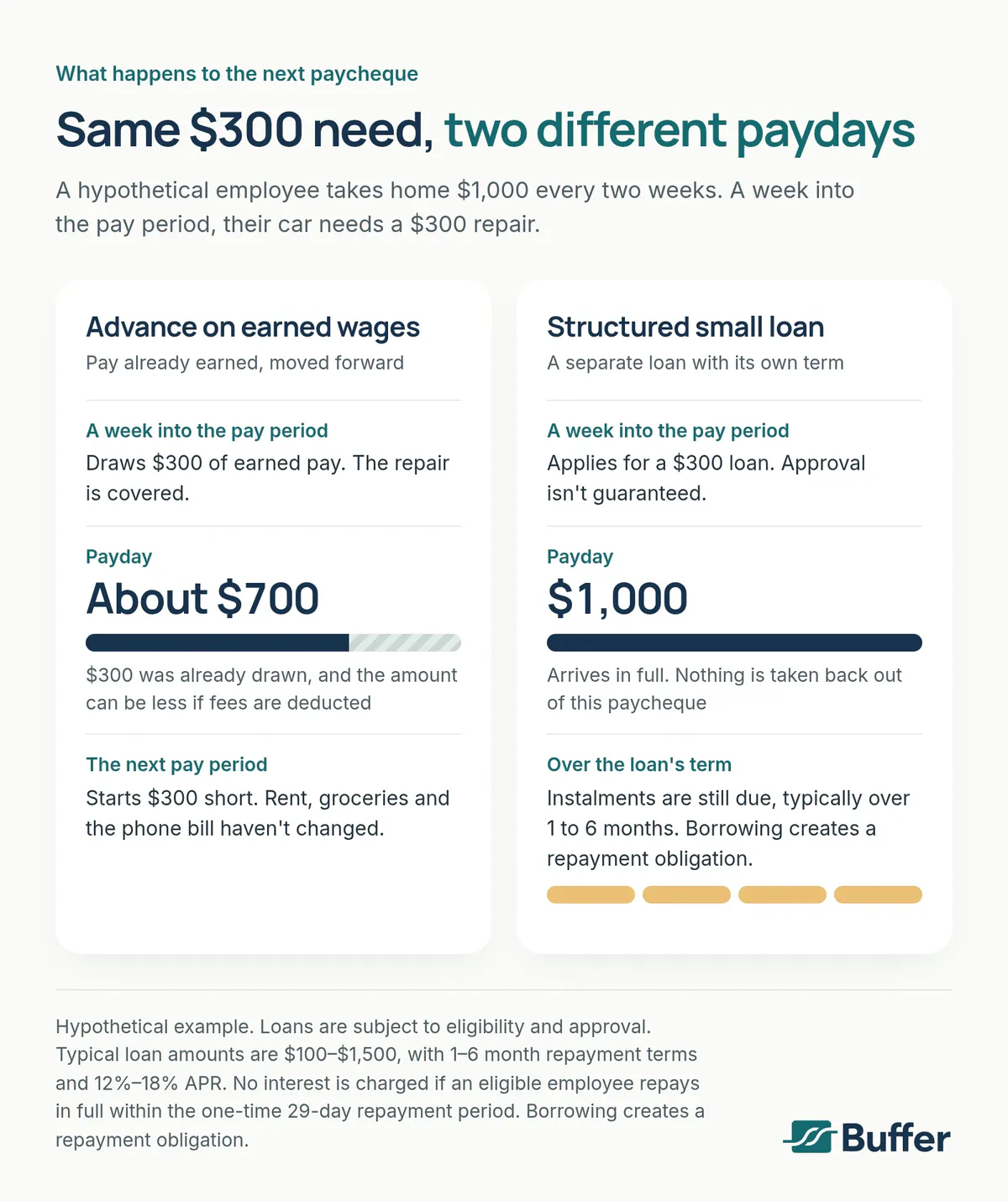
None of this makes EWA a bad benefit. For a gap of a few days, like a bill due on the 28th when payday is the 30th, moving pay forward can be exactly the right tool. The trouble starts when the shortfall is bigger than a few days’ pay, because then it carries into the next pay period.
How is a small loan different?
A structured small loan works the other way around. It isn’t drawn from pay the employee has already earned, so it doesn’t come back out of the next paycheque. It has its own amount, term and instalment schedule.
That’s a trade-off, not a free pass. The next paycheque arrives in full, but the instalments are still due, so part of the coming paycheques goes to repaying the loan over its term. Borrowing creates a repayment obligation. A loan can also cost interest, and it depends on an application being approved.
This is the model Buffer uses. Buffer provides emergency fund support through a voluntary employee financial wellness benefit at zero employer cost. Its core product is a structured personal loan, typically $100 to $1,500 CAD, with repayment terms typically between one and six months and an APR of 12% to 18%. Eligible employees who repay in full within the 29-day one-time repayment period pay no interest. There are no penalties or late fees. Underwriting considers employment, income and bank transaction history, not only traditional credit scores, and there’s no hard credit inquiry. Approval isn’t guaranteed. Buffer reports loans to credit bureaus, and if borrowers don’t pay their instalments, Buffer will report it to credit bureaus.
For your company, there are no setup, subscription or per-employee fees. You don’t fund the loans, make credit decisions, carry credit risk or handle repayment and collections, and there’s zero data shared with employers. Our piece on who funds the loans and takes the risk explains how that split works.
Here’s how the two models compare side by side.
| Advance on earned wages | Structured small loan (Buffer) | |
|---|---|---|
| What it is | Early access to pay already earned | A personal loan with its own term |
| How much | Capped at wages earned so far | Typically $100 to $1,500 CAD |
| How it’s paid back | Deducted at the next payroll | Instalments over typically 1 to 6 months |
| The next paycheque | Smaller by the amount drawn, plus any fees deducted | Arrives in full, but instalments are still due |
| Cost to the employee | Usually a free, slower option and a fee for instant delivery | 12% to 18% APR, with no interest for eligible employees who repay in full within the 29-day one-time repayment period |
| Employer’s role | The provider works through your payroll process | No funding, credit decisions, credit risk, repayment or collections |
To see how a loan’s APR, term and interest-free period add up, our guide to what a small loan will really cost walks through a worked example.
What should we ask before offering either one?
Sales material won’t answer everything. These questions get to the parts that affect employees most:
- How much can employees access, and when? For EWA, how much is available early in a pay period?
- What does an employee pay for each option, and is anything deducted from pay besides the amount they drew?
- What does our payroll team have to do, and how do the rules on deductions from pay apply in our province? A qualified adviser should answer the second part.
- What data moves between payroll, the provider and us, and who can see it?
- What happens if someone draws every pay period, or leaves the company with an advance or loan outstanding?
- For a loan benefit, what are the APR, amount and term ranges, and who carries the credit risk?
Our list of questions to ask before offering employees emergency loans goes further on borrowing costs, eligibility and communication.
So, is earned wage access a good employee benefit?
For short timing gaps, it can be a sensible, low-friction option. For an emergency bigger than a few days’ pay, a smaller next paycheque can turn one gap into the next one. The size of the need and the timing of the next pay matter more than the price tag.
Neither option replaces fair pay, predictable hours or non-borrowing support like an employee assistance program or a referral to an accredited credit counsellor. If your workforce is largely hourly, our look at financial support for hourly and shift workers covers the wider picture.
Questions and answers
Is earned wage access a loan?
It depends on how the program is built and where you are. In the United States, the Consumer Financial Protection Bureau’s December 2025 advisory opinion says employer-partnered EWA that meets certain conditions isn’t credit under its lending rules. Canada has no equivalent guidance yet, so check with a qualified adviser.
Does earned wage access cost the employer anything?
It varies by provider. In the US, the CFPB says providers earn revenue from employers, card fees, worker fees for faster delivery and sometimes subscriptions. Ask for the full fee schedule for both your company and employees, and what your payroll team has to do.
What happens to my next paycheque after a pay advance?
With earned wage access, the amount you drew is deducted at the next payroll, so that paycheque is smaller, and the deduction can include fees. Your regular bills stay the same, so plan for the smaller amount.
What are the alternatives to payroll advances?
For short gaps, the Financial Consumer Agency of Canada suggests options like asking for more time to pay bills or cashing in vacation days. Lower-cost credit, such as a line of credit, is another. Some employers also offer a structured small loan benefit with a set term, so the next paycheque isn’t reduced, though instalments are still due.
How can we help employees with emergency expenses without lending company money?
A third-party loan benefit is one route. With Buffer, employers don’t fund the loans, make credit decisions, carry credit risk or handle repayment. Non-borrowing support also matters, such as an employee assistance program or a referral to an accredited credit counsellor.
Is earned wage access legal in BC?
Rules vary by province, and they can depend on how a program is set up. Check with a qualified adviser before offering it.
How can I get money before payday in Canada?
The Financial Consumer Agency of Canada lists options such as asking for more time to pay a bill, cashing in vacation days, asking your employer for a pay advance or borrowing from family. It also lists options that are less expensive than a payday loan, such as a line of credit, overdraft protection or a credit card cash advance.
Is a small loan through my employer better than a payday loan?
On cost, usually yes. FCAC says that where payday loans are regulated, including BC, they can cost up to $14 per $100 borrowed, about 365% as an annual rate, and some or all is due on your next paycheque. Buffer, offered through workplaces, typically has a 12% to 18% APR and 1 to 6 month terms. Your employer isn’t the lender. Approval isn’t guaranteed, and borrowing creates a repayment obligation.
Sources and references
- Truth in Lending (Regulation Z); Non-application to Earned Wage Access Products (advisory opinion) · Consumer Financial Protection Bureau (Federal Register)
- Payday loans · Financial Consumer Agency of Canada
- Annual report 2025 to 2026 · Financial Consumer Agency of Canada
- Earned wage access outpaces Canadian law, leaving employers exposed · Human Resources Director (HRD Canada)
Product facts in this article were supplied by Buffer Financial Inc. This article is general information, not personal financial advice or an offer of credit.