

Contents
Key takeaways
- Financial Literacy Month runs every November. FCAC’s 2026 campaign, Talk Money, encourages purposeful conversations about money and offers a free toolkit.
- FCAC’s own workplace guidance notes that people may hold back sensitive questions in group sessions, and that live sessions are hard for shift and off-site workers to reach.
- Ask first with a short anonymous survey, explain the benefits people already have, and be explicit about part-time eligibility.
- Fraud is an easier way into money conversations. Canadians reported more than $704 million in fraud losses in 2025, including $50.6 million to job scams.
- Measure with an anonymous evaluation survey rather than attendance, keep vendors from selling, and don’t make the month about borrowing.
November is Financial Literacy Month in Canada, and if you work in HR, someone has probably already asked what you’re doing for it. The easy answer is a lunch-hour webinar. It’s quick to book and it looks like action. It’s also the format least likely to reach many of the people who’d get the most out of it.
Here are some alternatives that take about the same effort. One note before we start: this article isn’t affiliated with or endorsed by the Financial Consumer Agency of Canada (FCAC), which leads the campaign.
What is Financial Literacy Month about this year?
FCAC has run Financial Literacy Month every November since 2011. The 2026 campaign is called Talk Money, and it encourages people to have purposeful conversations about money: building an emergency fund, managing debt, planning for goals, weighing financial choices and protecting themselves from fraud. FCAC invites organizations to register their activities, and it offers a free Talk Money toolkit with posters, digital signage, a slide template and an evaluation survey.
The theme lines up with FCAC’s own data. Its annual report for 2025 to 2026 lists these indicators for 2025, drawn from its Monthly Financial Well-Being Monitor: 53% of Canadians struggled to keep up with financial commitments, 48% didn’t have emergency savings and 33% borrowed to cover regular expenses. The same report describes the Talk Money campaign as grounded in research showing that talking about money builds financial confidence and improves decision making.
Those are national figures, not a portrait of your team. Still, they suggest that in most workplaces a fair number of people are dealing with money pressure right now, and plenty of them won’t say so.
Why isn’t a webinar enough on its own?
There’s nothing wrong with webinars. FCAC’s guidance on delivery methods for workplace programs lists real advantages: they’re cost-effective, they reach several locations and they can be recorded. It’s also candid about the drawbacks. In a group, people may hold back sensitive questions, especially when they don’t know who else is on the call. Attention drifts to email. And live sessions are hard to reach for people who work off-site or on shifts.
That last point matters if much of your workforce is hourly. A noon webinar on a Tuesday misses the night crew, the weekend staff and anyone who doesn’t sit at a computer. Hourly and shift workers are also the group most likely to deal with pay that changes from week to week.
So if you run a webinar, treat it as one piece of the month. Here’s what else can work.
What can we do instead?
Ask before you plan
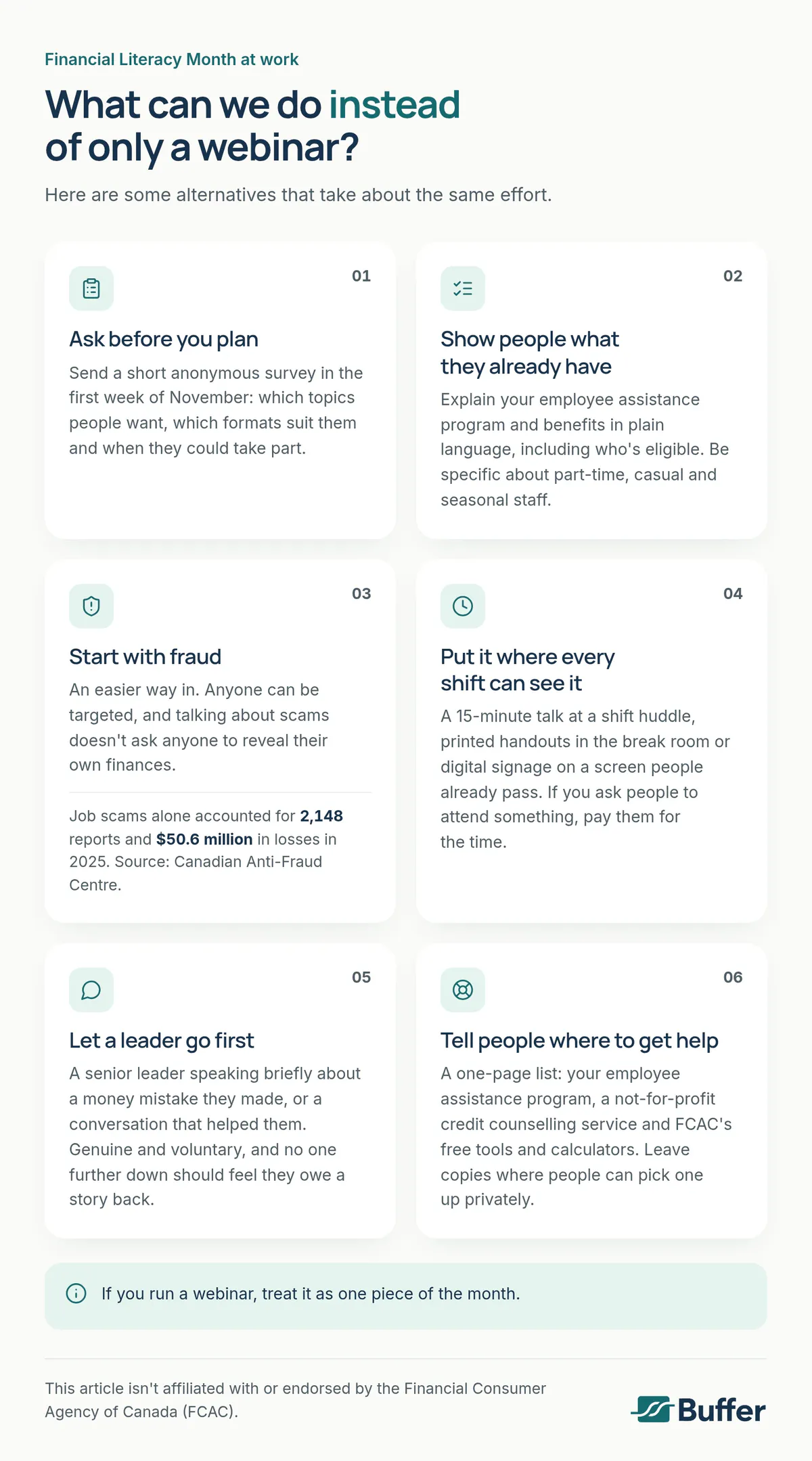
FCAC’s guide to planning a workplace financial wellness program says the best way to understand employees’ needs is to ask them, and that it doesn’t need to be complicated. A short anonymous survey in the first week of November can ask which topics people want, which formats suit them and when they could take part. FCAC suggests telling people their answers are confidential and will only be looked at as a group, which makes honest answers more likely. Then let what you hear shape the rest of the month.
Show people what they already have
Many workplaces already offer more than employees realize, like an employee assistance program that includes financial counselling, group benefits or a retirement savings plan. Financial Literacy Month is a good reason to explain each one in plain language, including who’s eligible. Be specific about part-time, casual and seasonal staff, because people in those roles often assume they’re left out. Our piece on financial wellness beyond workshops covers the other layers of support worth checking.
Start with fraud
Money conversations are hard partly because they can feel like confessions. Fraud is an easier way in. Anyone can be targeted, and talking about scams doesn’t ask anyone to reveal their own finances. FCAC’s toolkit makes fraud one of this year’s key messages, noting that stigma can make people reluctant to talk about it.
The numbers make the case. The Canadian Anti-Fraud Centre received more than 112,000 fraud reports in 2025, with more than $704 million in reported losses. Job scams alone accounted for 2,148 reports and $50.6 million in losses, which makes them directly relevant at work. And according to the Competition Bureau, only 5% to 10% of frauds are reported, so the real picture is bigger. A short session or a break-room poster on spotting fake job offers and phishing messages, and on where to report fraud, is useful to everyone and puts no one on the spot.
Put it where every shift can see it
FCAC’s delivery guidance recommends a mix of channels, written takeaways people can keep and timing that works for shift workers, such as sessions when shifts overlap. It also says offering time during work hours can increase participation and shows employees that financial literacy is a priority. In practice that could be a 15-minute talk at a shift huddle, printed handouts in the break room or the toolkit’s digital signage on a screen people already pass. If you ask people to attend something, pay them for the time.
Let a leader go first
FCAC suggests that a program champion or executive sponsor can set the tone by sharing a personal story, which helps create a safe space to talk about money. That’s the Talk Money idea in a single gesture. A senior leader speaking briefly about a money mistake they made, or a conversation that helped them, can do more for stigma than any slide deck. It should be genuine and voluntary, and no one further down should feel they owe a story back.
Tell people where to get help
FCAC recommends giving participants a contact number or another way to get help if they’re facing financial difficulties. A one-page list works: your employee assistance program, a not-for-profit credit counselling service and FCAC’s free tools and calculators. Leave copies where people can pick one up privately, not only at a session they’d have to be seen attending.
What could a simple November plan look like?
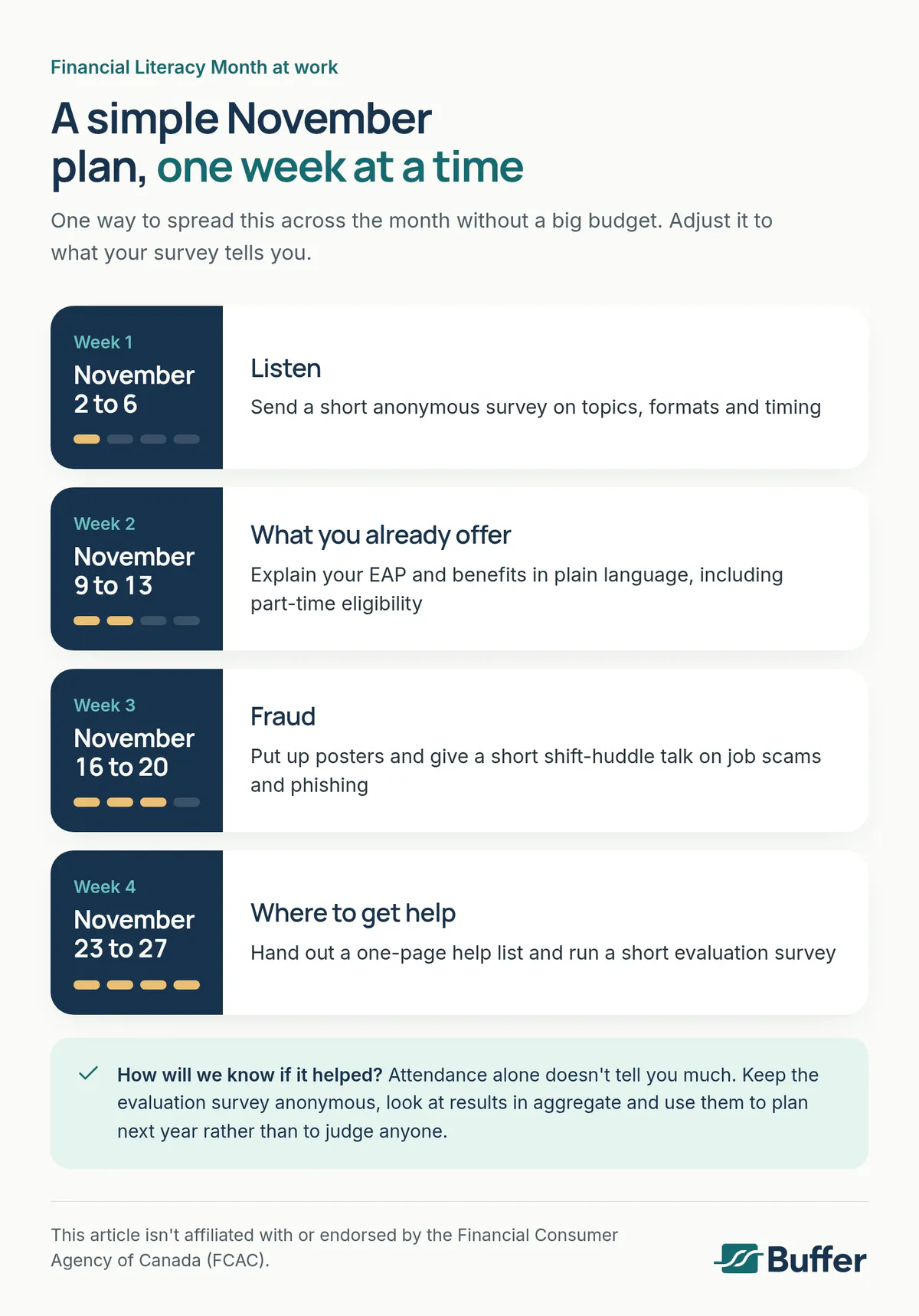
Here’s one way to spread this across the month without a big budget. Adjust it to what your survey tells you.
| Week | Focus | One thing to do |
|---|---|---|
| November 2 to 6 | Listen | Send a short anonymous survey on topics, formats and timing |
| November 9 to 13 | What you already offer | Explain your EAP and benefits in plain language, including part-time eligibility |
| November 16 to 20 | Fraud | Put up posters and give a short shift-huddle talk on job scams and phishing |
| November 23 to 27 | Where to get help | Hand out a one-page help list and run a short evaluation survey |
How will we know if it helped?
Attendance alone doesn’t tell you much. The Talk Money toolkit includes an evaluation survey template for workshops, webinars, discussion groups and campaigns. You can use some or all of its question sets and give it during or right after an activity. Keep it anonymous, look at results in aggregate and use them to plan next year rather than to judge anyone.
Be modest about what one month can do. A few conversations won’t change pay, hours or rent, and they won’t hand you a productivity figure to report upward. What they can do is make it a little easier for someone to ask for help the next time money gets tight.
What should we avoid?
A sales pitch in disguise. FCAC advises choosing outside providers that are objective and aren’t trying to sell a specific product or service, because employees who feel they’re being sold to may tune out. That applies to us as well.
Tracking individuals. Don’t record who attends which money session or pass that on to managers. Report group numbers only.
Making the month about borrowing. If your workplace offers a loan benefit, it’s fine to list it alongside your other supports as one option. It shouldn’t be the centrepiece of a month about money conversations. Our guide to announcing a loan benefit without pressure covers how to talk about one.
If you’re weighing emergency support for your team, Buffer is one model. It’s a voluntary employee benefit at zero employer cost: eligible employees can apply for structured personal loans of $100 to $1,500 CAD over one to six months, at 12% to 18% APR, with no hard credit inquiry. Employers don’t fund the loans, make credit decisions, carry credit risk or handle repayment. You can read more about who carries what in that model.
Questions and answers
When is Financial Literacy Month in Canada?
Every November. FCAC has led it since 2011 in support of the National Financial Literacy Strategy, and 2026 also marks FCAC’s 25th anniversary.
What is the theme for Financial Literacy Month 2026?
FCAC’s 2026 campaign is called Talk Money. It encourages purposeful conversations about money, including building an emergency fund, managing debt, planning for goals and protecting yourself from fraud.
Can our organization register Financial Literacy Month activities?
FCAC invites organizations to plan and register their activities, and those that do are recognized as part of the campaign. Taking part doesn’t mean FCAC endorses your organization or its products.
How do we measure whether our activities helped?
FCAC’s Talk Money toolkit includes an evaluation survey template for workshops, webinars, discussion groups and campaigns. You can use some or all of its question sets during or right after an activity. Keep it anonymous and look at results as a group.
Sources and references
- Financial Literacy Month · Financial Consumer Agency of Canada
- Financial Literacy Month 2026 Talk Money toolkit · Financial Consumer Agency of Canada
- Annual report 2025 to 2026 · Financial Consumer Agency of Canada
- Delivery methods for your financial wellness program · Financial Consumer Agency of Canada
- Plan your workplace financial wellness program · Financial Consumer Agency of Canada
- Top 10 frauds in 2025 · Canadian Anti-Fraud Centre
- Fraud Prevention Month to bring hidden crime into the spotlight · Competition Bureau Canada
Product facts in this article were supplied by Buffer Financial Inc. This article is general information, not personal financial advice or an offer of credit.