

Contents
Key takeaways
- Canada’s Consumer Price Index rose 3.1% year over year in October 2026, the same as in September. Prices rose 0.2% from September, and excluding energy they were up 2.0%.
- Gasoline was 30.9% higher than a year earlier, a faster pace partly due to a base-year effect, even though it fell 2.5% from September. Groceries rose 2.0%, up from 1.7%, and are 31.9% higher than in October 2020.
- Inflation eased in five provinces. BC slowed from 3.0% to 2.5% on slower rent growth; Ontario held at 2.5%; Nova Scotia was highest among the provinces at 5.9%.
- Average hourly wages rose 2.2% year over year in October, below 3.1% inflation, so the same paycheque buys a little less on average. Your own rate depends on what you buy, especially fuel.
- Next dates: Labour Force Survey December 4, Bank of Canada rate decision December 9 and November CPI December 14.
Canada’s inflation rate held at 3.1% in October 2026, the same as in September, according to Statistics Canada’s Consumer Price Index released November 16. Prices rose 0.2% from September. Excluding energy, prices were up 2.0% from a year earlier, after 2.1% in September.
So the headline number didn’t move, but what’s inside it did. Gasoline is still the main driver. Groceries and clothing sped up, while cell phone plans and slower rent growth held the total down. Here’s what it means for your paycheque.
What drove inflation in October?
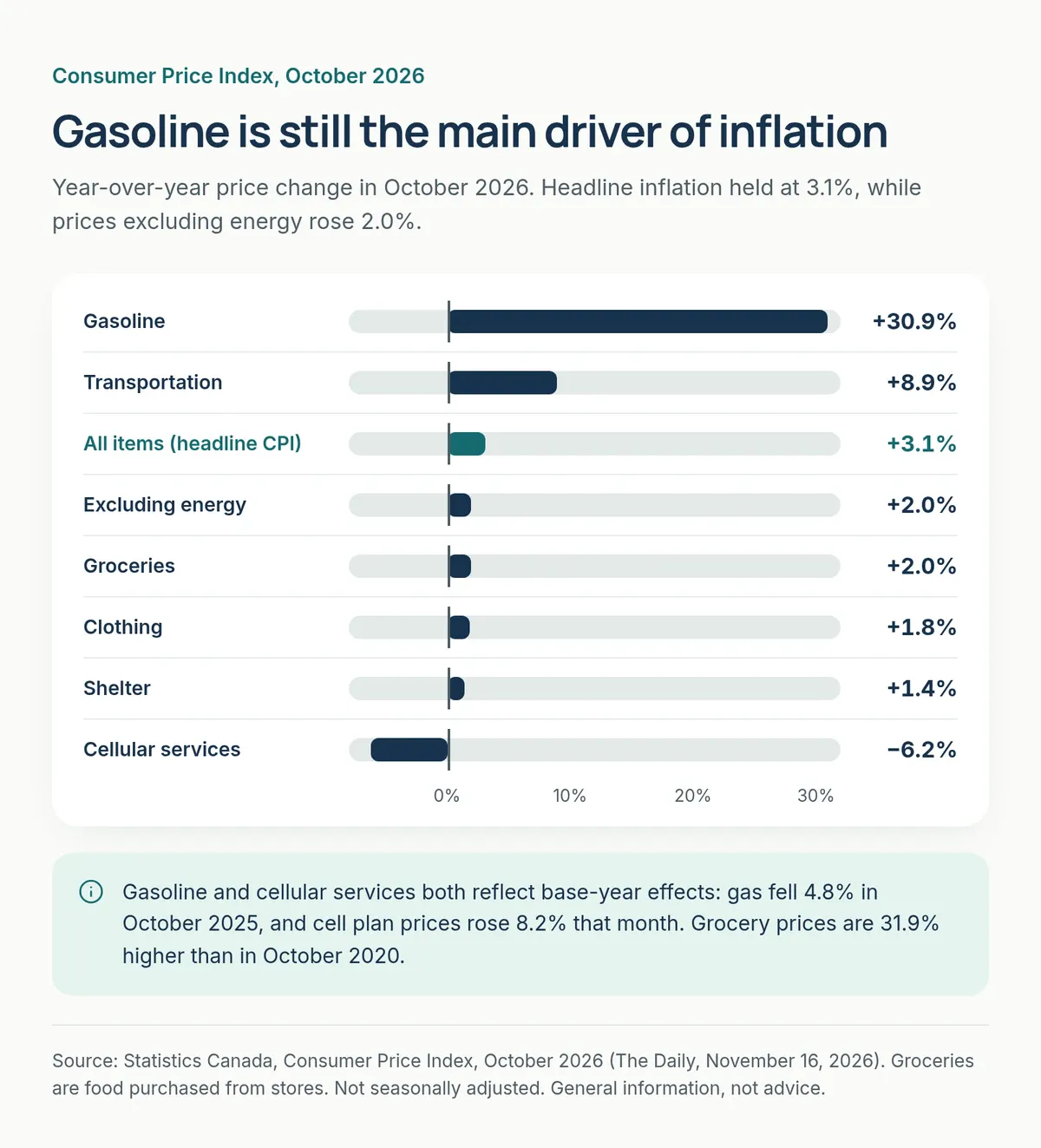
Gasoline. Gas prices were 30.9% higher than in October 2025, up from 27.8% in September. Part of that jump is a base-year effect: gas prices fell 4.8% in October 2025, and that drop no longer counts in the comparison. Gas actually fell 2.5% from September to October, but Statistics Canada says prices stayed elevated amid the conflicts in the Middle East and Ukraine. Transportation as a whole was up 8.9%.
Groceries. Food bought from stores rose 2.0% year over year, up from 1.7% in September, after four straight months of slower growth. Fresh vegetables led the turn. Grocery inflation was still below overall inflation for the third month in a row, but grocery prices are now 31.9% higher than in October 2020.
Clothing. Clothing prices rose 1.8% from a year earlier, after falling 0.3% in September. From September to October they jumped 3.4%, the largest monthly increase since September 2019, at a time of higher shipping costs.
What pulled the other way. Cellular services were 6.2% cheaper than a year earlier, mostly because several providers raised plan prices in October 2025 and that increase has dropped out of the comparison. Month over month, cell plans actually rose 0.6%. Shelter costs rose 1.4%, with rent growing more slowly.
What about BC and the other provinces?
Prices rose more slowly in five provinces in October than in September. In British Columbia, inflation eased from 3.0% to 2.5%, mainly because rent grew more slowly. Ontario held at 2.5%. Alberta eased to 3.3% and Quebec rose to 3.4%. The Atlantic provinces ran highest, led by Nova Scotia at 5.9%.
If you own a home, there’s one more line to watch. Property taxes and other special charges, which Statistics Canada prices once a year in October, rose 3.8% nationally, slower than the 5.6% increase a year earlier.
What does 3.1% inflation mean for your paycheque?
Start with the comparison most people feel. In October, average hourly wages rose 2.2% from a year earlier, according to the Labour Force Survey. Prices rose 3.1%. When pay grows more slowly than prices, the same paycheque buys a little less.
Averages hide a lot, though. Your own inflation rate depends on what you buy. If you drive a long commute and fill up every week, you’ve likely felt much more than 3.1%. If you take transit and your rent hasn’t changed, you may have felt less.
Here’s a hypothetical example, not a real person. Say your household spent $800 a month on groceries a year ago. If your basket rose in line with grocery inflation of 2.0%, the same food would cost about $816 a month now, or roughly $190 more over a year. Small on its own, but it adds up alongside fuel.
Practical steps for the next few weeks
- Find your own inflation rate. Statistics Canada’s Personal Inflation Calculator lets you enter what you spend and compare it with the official rate.
- Look at fuel first. Combining trips, carpooling or using transit some days can do more than trimming lots of small purchases.
- Plan for bills that bunch up. Property tax, winter heating and holiday costs often land close together. If your cushion already went to everyday bills, here’s how to rebuild an emergency fund.
- Watch rates as well as prices. The Bank of Canada raised its policy rate to 2.5% on October 28. More on what could come next: Will the Bank of Canada raise rates again in December 2026?
- Get free help early if debt is building. Start with How do I find debt help in Canada without getting ripped off?
What to watch next
- Friday, December 4: the Labour Force Survey for November. For October’s numbers, see what Canada’s October jobs report means for your paycheque.
- Wednesday, December 9: the Bank of Canada’s next rate announcement. Two core inflation measures the Bank tracks were close to 2% in October: CPI-median at 2.0% and CPI-trim at 1.8%. The Bank hasn’t said what it will do, and we won’t guess.
- Monday, December 14: the Consumer Price Index for November.
A note for employers
When pay grows more slowly than prices, it shows up at work as questions about hours, overtime, raises and the cost of getting to a shift. October’s pressure is concentrated in fuel and varies widely by province. If you’re reviewing pay for hourly teams, our look at what the 2026 living wage rates mean for employers is a practical place to start.
This article is general information, not financial, legal or credit advice. Buffer Financial is not affiliated with or endorsed by Statistics Canada or the Bank of Canada.
Questions and answers
What is Canada's inflation rate for October 2026?
3.1%. Statistics Canada’s Consumer Price Index rose 3.1% year over year in October 2026, matching September. Prices rose 0.2% from September to October. Excluding energy, prices rose 2.0%, after 2.1% in September.
Why are gas prices up so much from last year?
Gasoline prices were 30.9% higher than in October 2025, up from 27.8% in September. The faster pace is partly a base-year effect: gas prices fell 4.8% in October 2025 when crude oil prices were lower, and that drop no longer counts in the 12-month comparison. Gas prices fell 2.5% from September to October 2026 but stayed elevated amid conflicts in the Middle East and Ukraine, according to Statistics Canada.
Are grocery prices still going up in Canada?
Yes. Prices for food bought from stores rose 2.0% year over year in October 2026, up from 1.7% in September, after four months of slower growth. Fresh vegetables led the increase. Grocery prices are 31.9% higher than in October 2020.
What was BC's inflation rate in October 2026?
2.5%, down from 3.0% in September. Statistics Canada says the slowdown in British Columbia was mainly due to slower year-over-year growth in rent prices.
When is the next inflation report in Canada?
Statistics Canada will release the Consumer Price Index for November 2026 on Monday, December 14. The Bank of Canada’s next interest rate announcement is Wednesday, December 9.
Loans are subject to eligibility and approval. Typical loan amounts are $100–$1,500, with 1–6 month repayment terms and 12%–18% APR. No interest is charged if an eligible employee repays in full within the one-time 29-day repayment period. Borrowing creates a repayment obligation.
Sources and references
- Consumer Price Index, October 2026 · Statistics Canada (The Daily)
- Table 1: Consumer Price Index, major components and special aggregates, Canada · Statistics Canada
- Chart 5: The Consumer Price Index increases at a slower pace in five provinces · Statistics Canada
- Table 4: Consumer Price Index statistics, measures of core inflation, Bank of Canada definitions · Statistics Canada
- Labour Force Survey, October 2026 · Statistics Canada (The Daily)
- Bank of Canada raises the policy rate by 25 basis points to 2.5% · Bank of Canada
- Personal Inflation Calculator · Statistics Canada
Product facts in this article were supplied by Buffer Financial Inc. This article is general information, not personal financial advice or an offer of credit.
Follow Buffer
Add Buffer as a preferred source and Google will show you more of our articles.