

Contents
Key takeaways
- In a Willful and Angus Reid survey (September 2026), 47% of Canadian adults said they used savings to cover day-to-day expenses in the past year, near half for three years running.
- If everyday bills drained your fund, first work out whether it was a one-time squeeze or an ongoing gap where costs are higher than income.
- Rebuild with a small first target, an automatic payday transfer into a separate account, a separate line for predictable costs, and any windfalls or freed-up loan payments.
- Don’t borrow to refill savings. A loan swaps cash for a repayment obligation; it isn’t savings.
Maybe it was groceries one month and the hydro bill the next. Maybe it was rent after a short pay period. Either way, the money you set aside for emergencies is gone, and it didn’t go to an emergency. It went to ordinary life.
You have a lot of company. In The Great Delay 2026, a survey Willful commissioned from Angus Reid, 47% of Canadian adults said they had used savings to cover day-to-day expenses in the past year. It’s the third year in a row the number has landed near half: 48% in 2024 and 46% in 2025. Another 7% said they had no savings to dip into. The survey asked 1,501 adults from September 1 to 10, 2026. Willful sells online wills, and the sample is Canadian adults in general rather than workers only, so treat it as a broad snapshot.
Using savings to get through the month isn’t a personal failure. It does tell you something useful, and that’s where rebuilding starts.
What does it mean when savings go to everyday bills?
The Financial Consumer Agency of Canada (FCAC) describes an emergency fund as money for unexpected costs that don’t give you time to adjust your budget, such as a car repair, an urgent vet visit, a job loss or a health problem that stops you working. It separates those from occasional costs like winter tires, school supplies or holidays, which it says should already be planned for in your budget.
Groceries, rent and utilities are neither. They’re the base of the budget. So if those are what drained your savings, your fund was quietly doing a different job: covering a gap between what came in and what went out. Refilling it without looking at that gap usually means watching it drain again.
Was it a one-time squeeze or an ongoing gap?
A one-time squeeze looks like a short pay period, a month where several big bills landed together, or hours that were cut for a while and then came back. Once the squeeze passes, your regular pay covers your regular costs again. If your hours or your job changed recently, what Canada’s 6.7% unemployment rate means for your paycheque covers that side of things.
An ongoing gap is when essential costs are higher than income most months. That’s more common than it sounds. FCAC’s annual report for 2025 to 2026 says 26% of Canadians spent more than their income in 2025, and 33% borrowed to cover regular expenses.
FCAC’s budgeting guide suggests tracking everything you spend for one or two months, including bills, and sorting it into needs and wants. When you compare that with what you actually earn, it asks a useful question: is a difference due to an unusual situation, or is it likely to happen each month? Your answer tells you which kind of shortfall you’re dealing with.
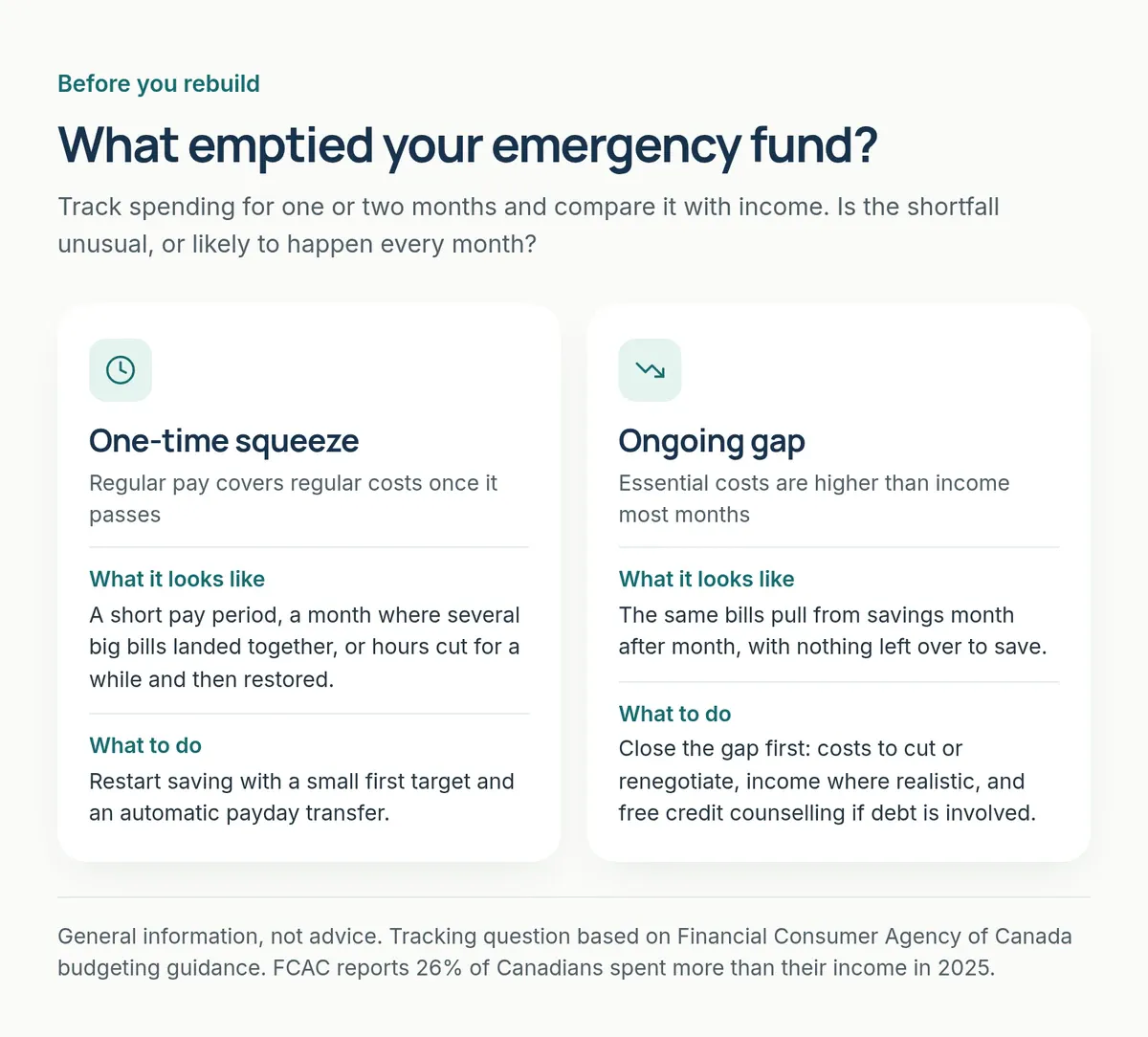
If it’s an ongoing gap, saving harder isn’t the first fix, because there’s nothing left over to save. The work is on the gap itself: costs you can cut, bills you can renegotiate, or more income where that’s realistic. If debt is part of the picture, free help exists. How do I find debt help in Canada without getting ripped off? explains how to tell a not-for-profit credit counsellor from a paid debt service.
How do I rebuild it, step by step?
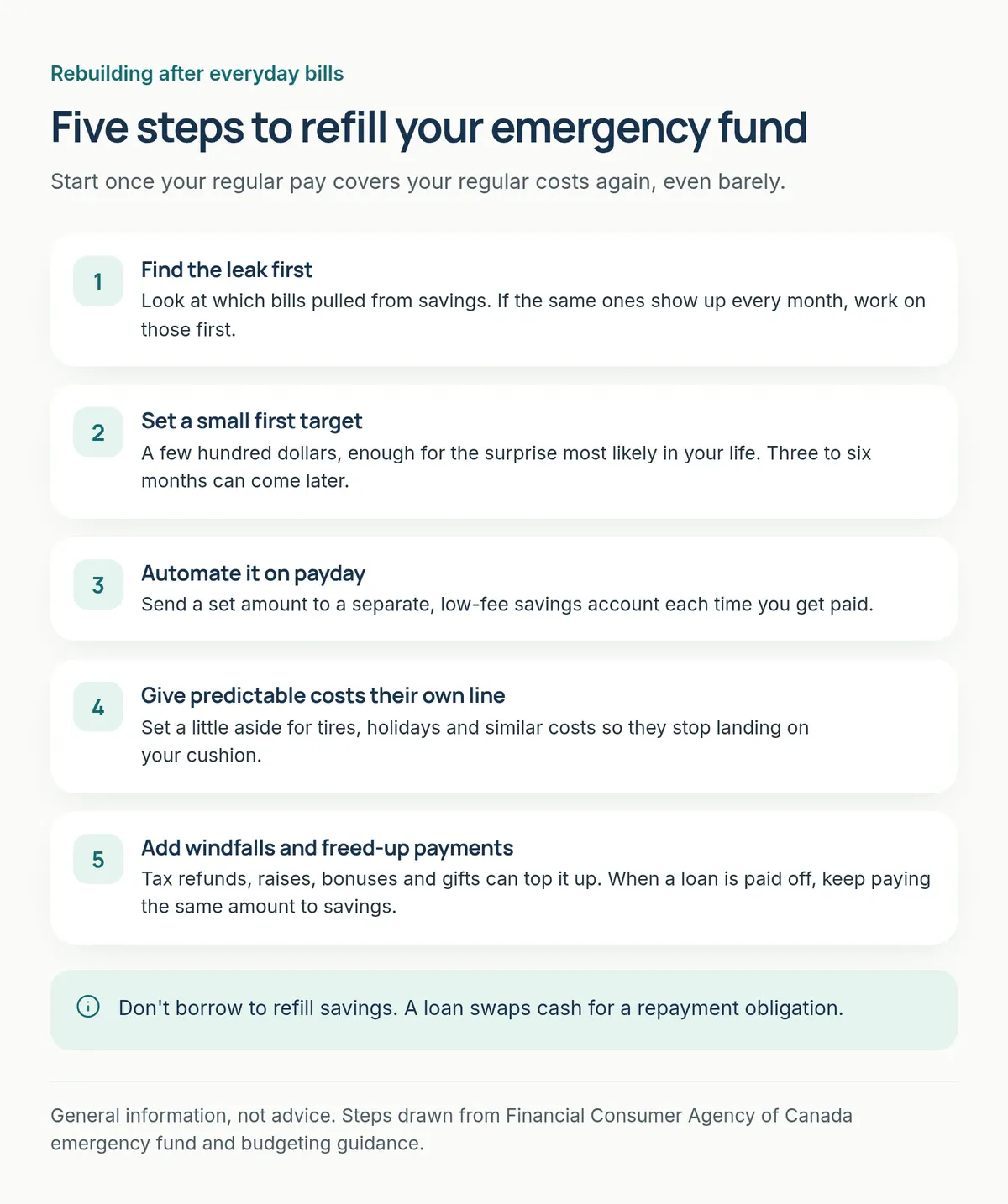
Once your regular pay covers your regular costs again, even barely, you can start refilling. These steps lean on FCAC’s guidance.
- Find the leak first. Look at which bills pulled from savings. If the same ones show up every month, that’s the place to work on before anything else.
- Set a small first target. FCAC’s ideal is three to six months of expenses, but it says getting there can take months or years and that starting small helps you avoid getting discouraged. A first target of a few hundred dollars, enough for the surprise most likely in your life, is a reasonable place to begin.
- Automate it on payday. FCAC suggests an automatic transfer on the days you get paid, into a savings account that’s separate from your everyday account, with low or no fees and no penalty for withdrawals.
- Give predictable costs their own line. If occasional costs like tires or holidays were part of what emptied the fund, set a little aside for each one separately so they stop landing on your cushion.
- Add windfalls and freed-up payments. FCAC points to tax refunds, raises, bonuses, gifts and money from selling something as chances to top up. When you finish paying off a loan, it suggests sending the same monthly amount to savings, since it’s already in your budget.
Here’s a hypothetical example, not a real person. Say you’re paid every two weeks and you set a first target of $600. A $30 transfer each payday gets you there in 20 paydays, or about 40 weeks. If you also put in a $200 tax refund, you’d need $400 from transfers, which takes 14 paydays, or about 28 weeks.
If you’re still starting from nothing at all, How do I start an emergency fund when my paycheque is spoken for? goes deeper on finding the first few dollars.
Should I pay down debt or rebuild savings first?
If the empty months left you with a card balance, it’s a fair question, and there isn’t one right answer for everyone. One common approach is to rebuild a small starter cushion while you keep up your debt payments, then put more toward the debt once that cushion exists. The reasoning is simple: with nothing set aside, the next surprise tends to land on the same card. That’s general information, not a rule, and a not-for-profit credit counsellor can help you weigh it for your own situation. And if your score looks fine but the month still doesn’t cover itself, My credit score is good, so why am I still short every month? explains why those are different questions.
Should I borrow to refill my emergency fund?
No. Borrowing to put money back into savings swaps cash for a repayment obligation. The account looks full again, but you owe that money plus any interest, paid from the same tight budget you’re trying to fix.
Borrowing is a separate question from saving. If a real emergency hits before your cushion is back, a loan may bridge it when the rest of your budget works, and Will a small loan fix my money problem? helps you tell a one-off gap from an ongoing one. Before you sign anything, check the full cost in dollars; What will a small loan cost me? walks through APR and total repayment.
If your employer offers Buffer, it’s one option for that kind of short-term emergency. Buffer provides structured personal loans to eligible employees, typically $100 to $1,500, with repayment terms of 1 to 6 months and an APR of 12% to 18%. No interest is charged if you repay in full within the one-time 29-day repayment period. Approval isn’t guaranteed. Borrowing creates a repayment obligation, and a loan is not savings. Learn how Buffer works.
Start smaller than you think
An emptied fund can feel like starting over. It isn’t quite. The fund did its job and got you through. Now work out what drained it, close that gap if it’s ongoing, and refill it a little at a time.
This article is general information, not financial, credit or legal advice. Buffer is not affiliated with or endorsed by Willful, Angus Reid or the Financial Consumer Agency of Canada.
Questions and answers
Is it normal to use an emergency fund for everyday bills?
It’s common. In Willful’s Great Delay 2026 survey with Angus Reid, 47% of Canadian adults said they used savings to cover day-to-day expenses in the past year, and another 7% said they had no savings to dip into. It’s not a personal failure, but it’s a sign to look at whether costs are outrunning income.
How much should I aim for when I rebuild?
FCAC’s ideal is three to six months of regular expenses, but it says that can take months or years and that starting small helps. A first target of a few hundred dollars, enough for the surprise most likely in your life, is a reasonable start. Raise the target once you reach it.
How do I know if it was a one-time squeeze or an ongoing gap?
FCAC suggests tracking everything you spend for one or two months and comparing it with your income. If the shortfall came from an unusual situation, such as a short pay period, it’s a one-time squeeze. If it’s likely to happen every month, it’s an ongoing gap, and that needs fixing before savings can grow.
Where should I keep my rebuilt emergency fund?
FCAC recommends a savings account that’s separate from your everyday account, with low or no transaction fees, withdrawals without penalty, and some interest. Keeping it separate makes it less likely to drift back into regular spending.
Should I pay down debt or rebuild savings first?
There isn’t one answer for everyone. One common approach is to rebuild a small starter cushion while keeping up debt payments, so the next surprise doesn’t land on the same card, then put more toward the debt. A not-for-profit credit counsellor can help you weigh it for your situation.
What if my costs are higher than my income every month?
Then saving isn’t the first fix. FCAC reports that 26% of Canadians spent more than their income in 2025. Look at costs you can cut or renegotiate and at income where that’s realistic, and consider free help from a not-for-profit credit counsellor if debt is involved.
Should I borrow to refill my emergency fund?
No. A loan used to refill savings leaves you owing the same amount plus any interest, paid from the same tight budget. Borrowing may help bridge a real emergency when the rest of your budget works, but it isn’t savings.
Can Buffer help if an emergency hits before I've rebuilt?
If your employer offers Buffer, eligible employees can apply for structured personal loans, typically $100 to $1,500 over 1 to 6 months at 12% to 18% APR. No interest is charged if you repay in full within the one-time 29-day repayment period. Approval isn’t guaranteed. Borrowing creates a repayment obligation.
Loans are subject to eligibility and approval. Typical loan amounts are $100–$1,500, with 1–6 month repayment terms and 12%–18% APR. No interest is charged if an eligible employee repays in full within the one-time 29-day repayment period. Borrowing creates a repayment obligation.
Sources and references
- The Great Delay 2026: Why Canada's Sandwich Generation Is Planning for Everyone but Themselves · Willful (survey by Angus Reid)
- Setting up an emergency fund · Financial Consumer Agency of Canada
- Making a budget · Financial Consumer Agency of Canada
- Annual report 2025-2026 · Financial Consumer Agency of Canada
Product facts in this article were supplied by Buffer Financial Inc. This article is general information, not personal financial advice or an offer of credit.
Follow Buffer
Add Buffer as a preferred source and Google will show you more of our articles.