

Contents
Key takeaways
- On October 28, 2026, the Bank of Canada raised its policy rate from 2.25% to 2.5%, its first increase since July 2023. The Governing Council weighed holding at 2.25% against raising to 2.5%.
- Its summary of deliberations, published November 10, says there could be a need to increase the rate further, but decisions will be taken one meeting at a time. The next decision is December 9.
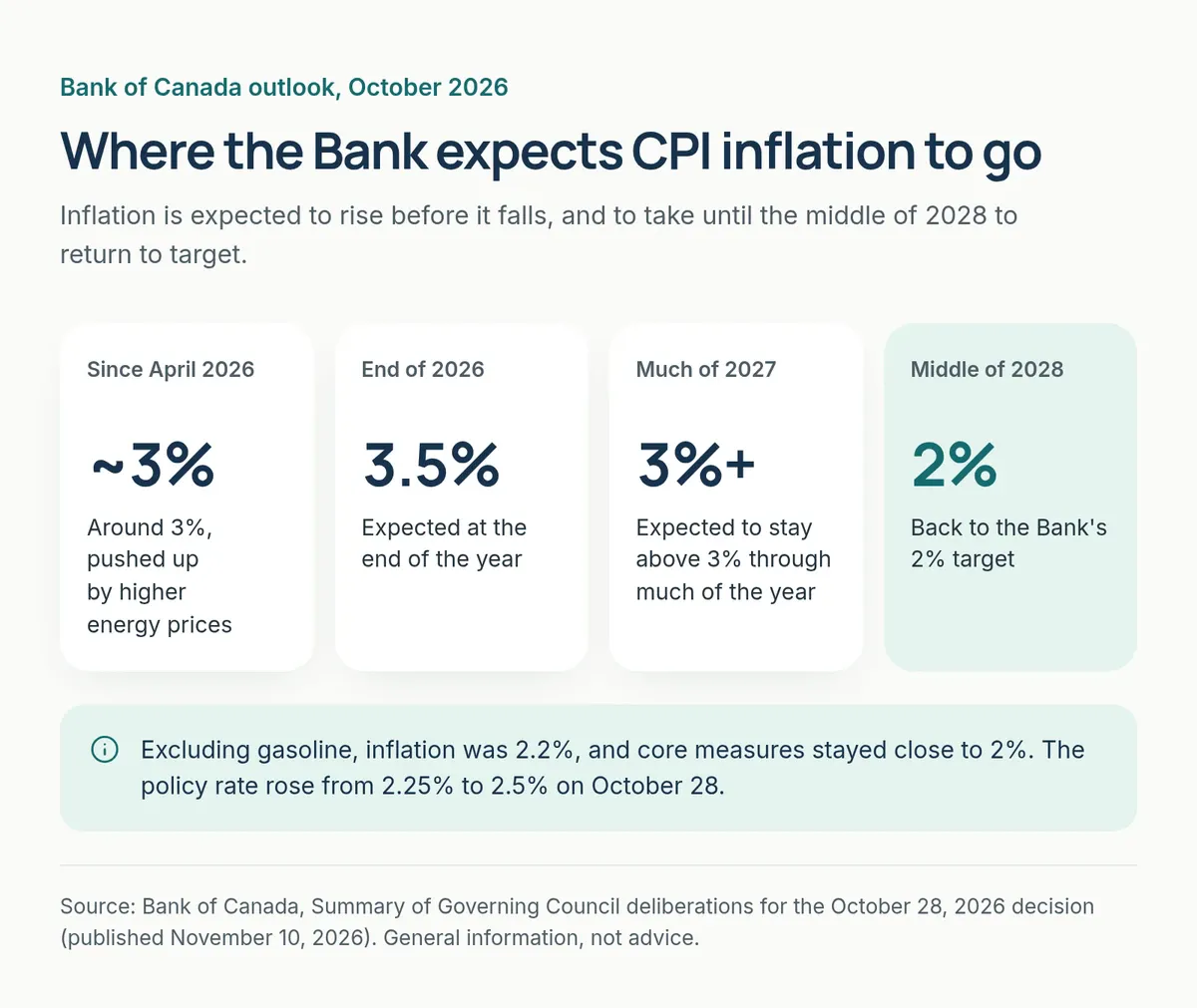
- The Bank expects CPI inflation, around 3% since April, to reach 3.5% at the end of 2026, stay above 3% through much of 2027 and return to 2% by the middle of 2028.
- Variable-rate loans and lines of credit usually move with the policy rate; fixed-rate loans change at renewal. List what floats and check your renewal dates.
The Bank of Canada’s next interest rate decision is on Wednesday, December 9, 2026. On November 10, the Bank published its summary of Governing Council deliberations for the October 28 decision. It shows what the Bank is weighing before the next one.
The short version: members agreed “there could be a need to increase the policy rate further,” but said they would take decisions “one meeting at a time with the benefit of the best available information.” So another increase is possible, not promised. Here’s what it means for your loan payments and budget.
What did the Bank of Canada decide on October 28?
The Bank raised its policy interest rate by a quarter of a percentage point, from 2.25% to 2.5%, according to its October 28 announcement. Governor Tiff Macklem told the House of Commons finance committee on November 3 that it was the first interest rate increase since July 2023.
The Governing Council looked at two options: hold at 2.25% or raise to 2.5%.
The case for holding was that inflation had mostly come from energy, and from services that rely heavily on energy, such as airfares. Inflation excluding gasoline was still 2.2%, and core measures of inflation stayed close to 2%. Some slack remained, and new US tariffs were expected to weigh on growth.
The case for raising was that gasoline, diesel and heating oil cost considerably more than in July and were expected to stay higher for longer. Businesses had mostly absorbed higher costs so far, but Bank surveys suggested they would pass more on to customers over the next year.
The Council chose to raise, to reduce the risk that high energy prices would spread to other goods and services and become persistent inflation.
The numbers behind the decision
- Oil: the benchmark price was about US$35 a barrel higher than the Bank had assumed in July.
- Inflation: CPI inflation has been around 3% since April. The Bank expects it to reach 3.5% at the end of 2026, stay above 3% through much of 2027, then gradually return to the 2% target by the middle of 2028.
- Growth: GDP grew 3.3% in the second quarter and about 2% was expected in the third. The Bank expects growth of 1% in 2026 and 2% in 2027 and 2028.
- Jobs: unemployment was around 6.5%, with the labour market moving sideways since the start of the year.
One line matters for household budgets: even without businesses passing on more costs, members said the energy shock alone would keep CPI inflation around 3% for more than a year.
What could this mean for your loan payments?
The policy rate isn’t the rate you pay, but many lenders’ rates follow it. Variable-rate mortgages and many lines of credit are usually tied to a lender’s prime rate, which tends to move with the policy rate. Fixed-rate loans and mortgages keep their rate until the term ends, so the change reaches you at renewal.
Here’s a hypothetical example, not a real person. Say you carry a $10,000 balance on a line of credit tied to prime, and your rate rises by a quarter point, the same size as the October 28 increase. You’d pay about $25 more in interest over a year, or roughly $2 a month. Small on its own. The harder part is the combination: borrowing costs a little more while everyday prices rise around 3%.
What can you do before December 9?
- List anything that floats. Write down each variable-rate loan or line of credit, with its balance and rate. Those payments could change again.
- Check your renewal dates. If a fixed-rate mortgage or loan renews within a year, ask your lender what the payment would be at current rates.
- Plan for prices around 3%. If your pay isn’t rising that fast, everyday costs take a bigger share of each paycheque. If your cushion already went to bills, here’s how to rebuild an emergency fund.
- Know what a loan really costs. If you’re borrowing for a gap, compare the total cost, not just the payment. What will a small loan cost me? walks through it.
- Get free help if debt is piling up. Start here: How do I find debt help in Canada without getting ripped off?
What to watch before the next decision
- Monday, November 16: Statistics Canada releases the Consumer Price Index for October 2026.
- Friday, December 4: the Labour Force Survey for November 2026. For the October numbers, see what Canada’s October jobs report means for your paycheque.
- Wednesday, December 9, 9:45 a.m. ET: the Bank’s next rate announcement.
The Bank said its outlook is subject to considerable uncertainty, including the war in the Middle East, Canada-US trade relations and how far businesses pass on higher costs. It didn’t say what it will do in December, and we won’t guess. Budget 2026 is a separate story: what it means for your paycheque.
A note for employers
Employees may feel this twice: higher fuel and heating costs, and loan payments that rise with rates. If people ask, plain information on renewal dates and free credit counselling helps more than a general reminder to budget.
This article is general information, not financial, legal or credit advice. Buffer is not affiliated with or endorsed by the Bank of Canada.
Questions and answers
Will the Bank of Canada raise rates in December 2026?
The Bank hasn’t said. In its summary of deliberations for the October 28 decision, published November 10, 2026, the Governing Council agreed there could be a need to increase the policy rate further, but said it would take decisions one meeting at a time with the best available information. The next decision is Wednesday, December 9, 2026.
What is the Bank of Canada's interest rate now?
The policy rate is 2.5%. The Bank raised it by 25 basis points from 2.25% on October 28, 2026. Governor Tiff Macklem told the House of Commons finance committee it was the first increase since July 2023.
Why did the Bank of Canada raise rates in October 2026?
Oil was about US$35 a barrel higher than the Bank assumed in July, gasoline, diesel and heating oil cost considerably more, and Bank surveys suggested businesses would pass on more cost increases over the next year. The Council raised the rate to reduce the risk that high energy prices would turn into broader, persistent inflation.
When does the Bank of Canada expect inflation to return to 2%?
By the middle of 2028. The Bank expects CPI inflation, which has been around 3% since April, to reach 3.5% at the end of 2026 and stay above 3% through much of 2027 before gradually declining to the 2% target.
Does a Bank of Canada rate increase change my loan payment?
It depends on the loan. Variable-rate mortgages and many lines of credit are usually tied to a lender’s prime rate, which tends to move with the policy rate. Fixed-rate loans and mortgages keep their rate until the term ends, so a change shows up at renewal. Check your own loan terms with your lender.
Loans are subject to eligibility and approval. Typical loan amounts are $100–$1,500, with 1–6 month repayment terms and 12%–18% APR. No interest is charged if an eligible employee repays in full within the one-time 29-day repayment period. Borrowing creates a repayment obligation.
Sources and references
- Summary of Governing Council deliberations: Fixed announcement date of October 28, 2026 · Bank of Canada
- Bank of Canada raises the policy rate by 25 basis points to 2.5% · Bank of Canada
- Opening Statement before the House of Commons Standing Committee on Finance · Bank of Canada (Tiff Macklem)
- Release schedule, November 9 to 20, 2026 · Statistics Canada
Product facts in this article were supplied by Buffer Financial Inc. This article is general information, not personal financial advice or an offer of credit.
Follow Buffer
Add Buffer as a preferred source and Google will show you more of our articles.