

Contents
Key takeaways
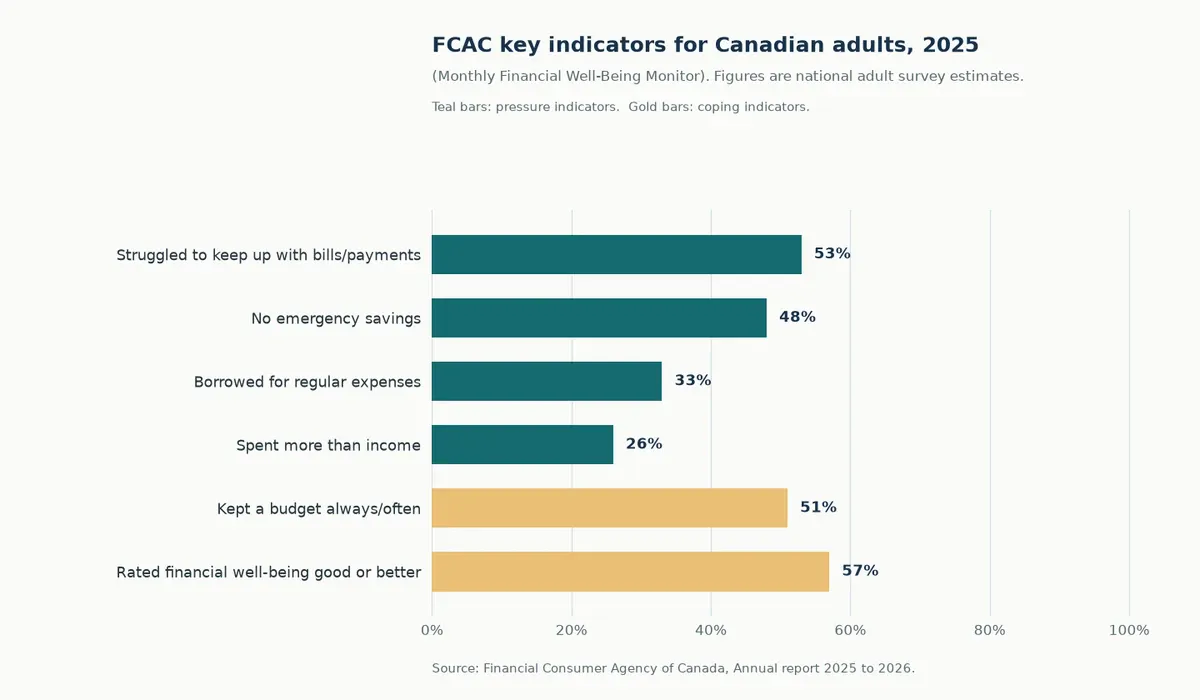
- FCAC’s 2025 indicators include 48% without emergency savings, 33% borrowing for regular expenses and 53% struggling to keep up with bills and payments.
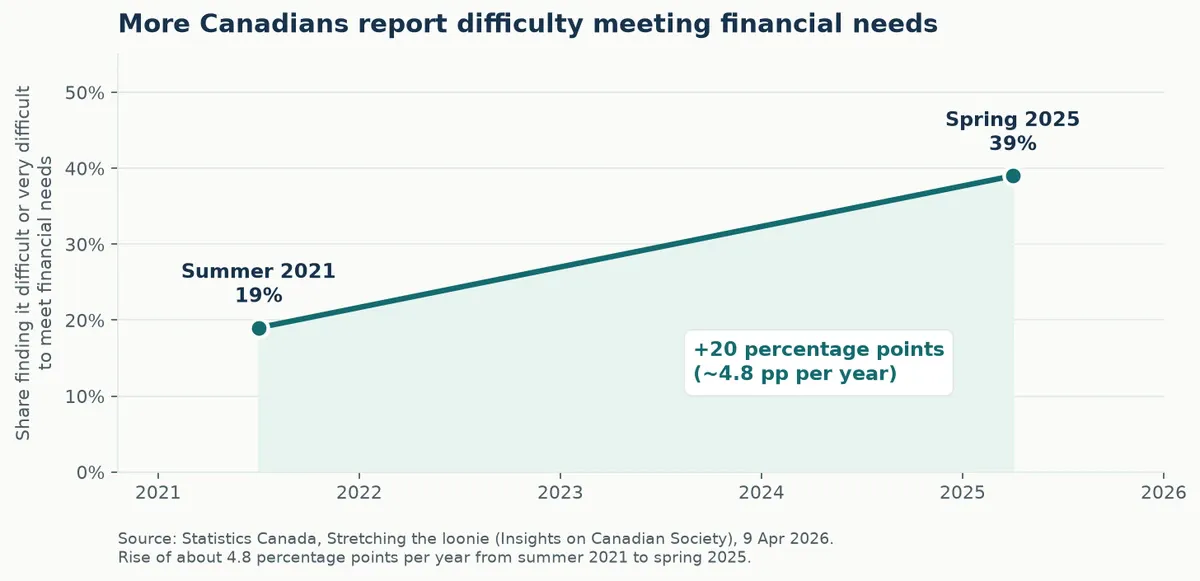
- Statistics Canada reports 39% of Canadians found it difficult or very difficult to meet financial needs in spring 2025, up from 19% in summer 2021.
- National Payroll Institute’s 2026 survey found 44% of employed respondents financially stressed and estimated $74.3 billion in lost productivity.
- FP Canada (2026) found money was the top stress source for 43% of Canadians; ADP Canada (October 2026) found 32% named salary and financial pressures as their biggest workplace anxiety source.
- Cite the primary source for each figure. Survey methods differ, and older snapshots should be dated.
Canadian surveys in 2025 and 2026 keep pointing the same way: money pressure is common, it shows up at work, and it falls harder on people with thinner cushions. This page gathers the figures most useful for employers, journalists and researchers, each with a source you can open yourself.
It is a citation roundup, not a diagnosis of any one workplace. Survey methods differ. Some samples are probability-based; many employer-facing polls use online panels. Where a figure is older, the date is called out.
For a narrative reading of the same research for HR leaders, see How stressed are Canadian employees about money right now?.
Savings and the emergency cushion
- 48% of Canadians did not have emergency savings in 2025, according to the Financial Consumer Agency of Canada (FCAC) annual report for 2025 to 2026. The figure comes from FCAC’s Monthly Financial Well-Being Monitor. In the questionnaire published for an earlier wave of that survey, people were asked about funds that would cover about three months of expenses, so some of that 48% may have smaller savings.
- 33% borrowed to cover regular expenses in 2025 (same FCAC annual report / Monthly Financial Well-Being Monitor).
- 26% of Canadians said in fall 2022 that their household could not cover an unexpected expense of $500 from household resources, according to Statistics Canada’s Canadian Social Survey release (13 February 2023). Treat this as an older snapshot; newer national cushion figures should be preferred when available.
- In the National Payroll Institute’s 2026 survey of working Canadians (fieldwork 22 to 30 June 2026; 2,196 employed respondents), 28% said they would struggle to meet financial obligations if a paycheque were delayed by one week, and 48% said they would value an employer-sponsored emergency savings program.
Debt and credit pressure
- Total Canadian consumer debt reached $2.68 trillion in the second quarter of 2026, up 4.18% from a year earlier, according to Equifax Canada’s Q2 2026 Market Pulse (24 August 2026).
- Non-mortgage debt was $712.2 billion in Q2 2026, up 4.8% year over year (same Equifax release).
- The national 90+ day non-mortgage balance delinquency rate was 1.76% in Q2 2026, down slightly from 1.79% in Q1 but above 1.70% a year earlier (same Equifax release).
- In the National Payroll Institute’s 2026 survey, 37% of working Canadians said they were carrying more debt than in previous years, 42% said debt was affecting their ability to save, and 30% felt overwhelmed by debt.
- FP Canada’s 2026 Financial Stress Index (fieldwork 6 to 15 January 2026; 2,002 respondents) found 33% of Canadians were paying down debt as a step to reduce financial stress.
Stress at work and productivity
- 44% of employed respondents in the National Payroll Institute’s 2026 survey were considered financially stressed, up from roughly one-third historically in the Institute’s framing of the series.
- The same survey estimated financial stress was costing employers and the Canadian economy about $74.3 billion in lost productivity.
- Nearly one in four employed respondents said personal financial stress was affecting their performance at work, rising to 53% among those already classed as financially stressed.
- Nearly one-third of employed respondents said they spent more than 30 minutes per workday dealing with or thinking about personal finances.
- FP Canada found money remained the leading source of stress for 43% of Canadians in 2026, ahead of health (21%), relationships (17%) and work (15%).
- ADP Canada’s Happiness@Work Index for October 2026 (fielded early October 2026; 1,926 employed adults) found 32% of workers surveyed named salary and financial pressures as their biggest source of anxiety.
- ADP Canada’s June 2026 Index found 42% of workers surveyed said a single full-time job was not enough to comfortably support their lifestyle, while 55% said it was.
Cost of living and who feels it most
- Statistics Canada’s Stretching the loonie (Insights on Canadian Society, 9 April 2026) reported that 39% of Canadians found it difficult or very difficult to meet financial needs in spring 2025, up from 19% in summer 2021, a rise of about 4.8 percentage points per year.
- In spring 2024, 53% of people in households with income under about $41,800 reported difficulty meeting financial needs, compared with 24% in households over about $155,000 (same StatCan analysis).
- In 2024, 18.5% of Canadian employees earned less than the low-pay threshold (two-thirds of median hourly earnings), according to Statistics Canada’s Employees with low pay, 2024 (18 August 2025). The share was 62.5% in accommodation and food services and 52.1% in retail trade.
- Groceries were the largest source of financial stress for 55% of National Payroll Institute respondents in 2026, and FP Canada found groceries were the most significant household pressure for 64% of Canadians in its 2026 index.
- Only 18% of National Payroll Institute respondents believed their income increases were keeping pace with the rising cost of living.
- In the Bank of Canada’s Canadian Survey of Consumer Expectations for the third quarter of 2026 (fieldwork 5 to 27 August 2026), about half of consumers continued to expect the Canadian economy to fall into a recession over the next 12 months, and spending intentions remained weak while high prices stayed the top barrier to spending.
What employees say they want from employers
- 48% of National Payroll Institute respondents said they would value an employer-sponsored emergency savings program; 78% participate when a “pay yourself first” payroll savings program is offered, though only 23% currently have access (2026 survey).
- 85% of Canadians in FP Canada’s 2026 index said they were taking steps to reduce financial stress, up from 82% in 2025. Common steps included tracking expenses (42%), paying down debt (33%), creating a budget (29%) and saving more (33%).
- FCAC’s 2025 indicators also show 51% of Canadians always or often kept a budget, and 57% rated their financial well-being as good or better, reminders that stress and coping behaviours often sit side by side.
For practical November activities that do not rely only on a webinar, see What can we do for Financial Literacy Month besides a webinar?. For building a first cushion when every paycheque is spoken for, see How do I start an emergency fund when my paycheque is spoken for?. For program design beyond workshops, see Financial wellness beyond workshops.
How to cite this page
Buffer Financial. “Canadian employee financial stress statistics (2026).” mybuffer.ca, published [insert date]. https://mybuffer.ca/blog/canadian-employee-financial-stress-statistics-2026
When you reuse an individual figure, cite the primary source named next to that figure (FCAC, Statistics Canada, National Payroll Institute, FP Canada, ADP Canada, Equifax Canada or Bank of Canada), not only this page.
Methodology note
Every statistic on this page was checked against a primary page or official news release opened on 30 October 2026. Percentages are reported as the source stated them. Online panel surveys (including National Payroll Institute, FP Canada / Leger, and ADP Canada / Harris Poll) are not simple random samples of all Canadian workers; treat margins and subgroup cuts with care. FCAC Monthly Financial Well-Being Monitor figures are national adult estimates. Statistics Canada figures follow the methods stated in each release. Equifax figures reflect consumer credit files, not survey opinions. Older figures (notably the fall 2022 $500 unexpected-expense result) are labelled as such.
This page is not affiliated with or endorsed by FCAC, Statistics Canada, the Bank of Canada or any survey publisher named above.
Soft note on Buffer
If your employer offers Buffer, it is one structured option for a short-term gap: personal loans typically between $100 and $1,500 CAD, with repayment terms typically between one and six months and an APR of 12% to 18%. There is no hard credit inquiry, and Buffer does not charge penalties or late fees. Approval is not guaranteed, and a loan is a repayment obligation, not savings. Learn how Buffer works.
Questions and answers
Can I cite these statistics in an article or report?
Yes. Prefer the primary source next to each figure (FCAC, Statistics Canada, National Payroll Institute, FP Canada, ADP Canada, Equifax Canada or Bank of Canada). You can also cite this page as a roundup, using the How to cite this page line above.
Do these numbers describe every Canadian workplace?
No. Most figures are national adult or employed-adult survey estimates, or credit-file aggregates. They are a signal for employers, not a census of any one company.
Why is the $500 unexpected-expense figure from 2022 still listed?
It is a clear Statistics Canada snapshot that is still widely quoted. It is labelled as fall 2022 data so readers do not treat it as a 2026 finding. Prefer newer cushion measures when your audience needs a current number.
Is Buffer or this page endorsed by FCAC or Statistics Canada?
No. This page gathers publicly available figures. It is not affiliated with or endorsed by FCAC, Statistics Canada, the Bank of Canada or the survey publishers named here.
Sources and references
- Annual report 2025 to 2026 · Financial Consumer Agency of Canada
- Stretching the loonie: A time series analysis of financial difficulty and quality of life · Statistics Canada
- One in four Canadians are unable to cover an unexpected expense of $500 · Statistics Canada (The Daily)
- Employees with low pay, 2024 · Statistics Canada
- Canadians are on a Financial Crash Course (2026 Annual Survey of Working Canadians) · National Payroll Institute (via CNW)
- FP Canada 2026 Financial Stress Index · FP Canada (via CNW)
- Canadian Survey of Consumer Expectations - Third Quarter of 2026 · Bank of Canada
- Non-Mortgage Delinquency Growth Slows in Second Quarter… (Q2 2026 Market Pulse) · Equifax Canada
- Happiness@Work Index: Worker Happiness Remains Strong during Spooky Season · ADP Canada
- Happiness@Work Index: Workplace Happiness Holds Steady Heading into Summer · ADP Canada
Product facts in this article were supplied by Buffer Financial Inc. This article is general information, not personal financial advice or an offer of credit.