

Contents
Key takeaways
- FCAC describes a payday loan as a short-term, high-cost loan of up to $1,500 with up to 62 days to repay, usually due around the next payday.
- In provinces with payday rules, the cost is capped at $14 per $100 borrowed. On FCAC’s example, a $300 loan for 14 days costs $42, roughly 365% a year, against $5.92 to $7.65 for a line of credit, overdraft or cash advance.
- FCAC research found payday loan users are often under strain: 43% said they were struggling a lot, and only 25% recognized payday loans as more expensive than other credit.
- Buffer Financial’s employer loan benefit offers loans typically of $100 to $1,500 at 12% to 18% APR over 1 to 6 months, with no late fees and no hard credit inquiry, at zero cost to the employer. Approval isn’t guaranteed.
- Budget 2026 announced plans for a 42-day minimum term, instalments and a ban on credit insurance for payday loans. These changes aren’t law yet.
A payday loan is fast and easy to get, but it’s one of the most expensive ways to borrow in Canada. A typical one costs $14 for every $100 borrowed and is due around your next payday. An employer loan benefit, such as the one Buffer Financial offers, is a voluntary personal loan with an annual percentage rate (APR) of 12% to 18% and repayment spread over 1 to 6 months, at zero cost to the employer.
That’s the short answer. If you’re in HR, benefits or finance and weighing whether a loan benefit belongs in your package, the details matter, because some of your people may already be using payday loans when an unexpected bill shows up. Here’s how the two compare, using official Canadian sources.
What is a payday loan in Canada?
The Financial Consumer Agency of Canada (FCAC) describes a payday loan as a short-term, high-cost loan of up to $1,500 that you may have up to 62 days to repay. You may qualify without a credit check, you pay a flat fee rather than interest if you pay on time, and the lender organizes payments around your payday. Some or all of the loan is due when your next paycheque arrives.
Those limits come from the Criminal Code. Charging interest above the criminal rate, now an APR of 35%, is an offence under section 347. Section 347.1 exempts payday loans of $1,500 or less with terms of 62 days or less, as long as the lender is licensed in a province that has its own payday rules and cost limits.
Provinces fill in the rest. In British Columbia, Consumer Protection BC says a payday loan can’t be more than 50% of your paycheque, lenders can’t issue more than one loan at a time or roll a loan over, and borrowers have two business days to cancel. Rules differ from province to province, so BC’s aren’t national.
How much does a payday loan cost?
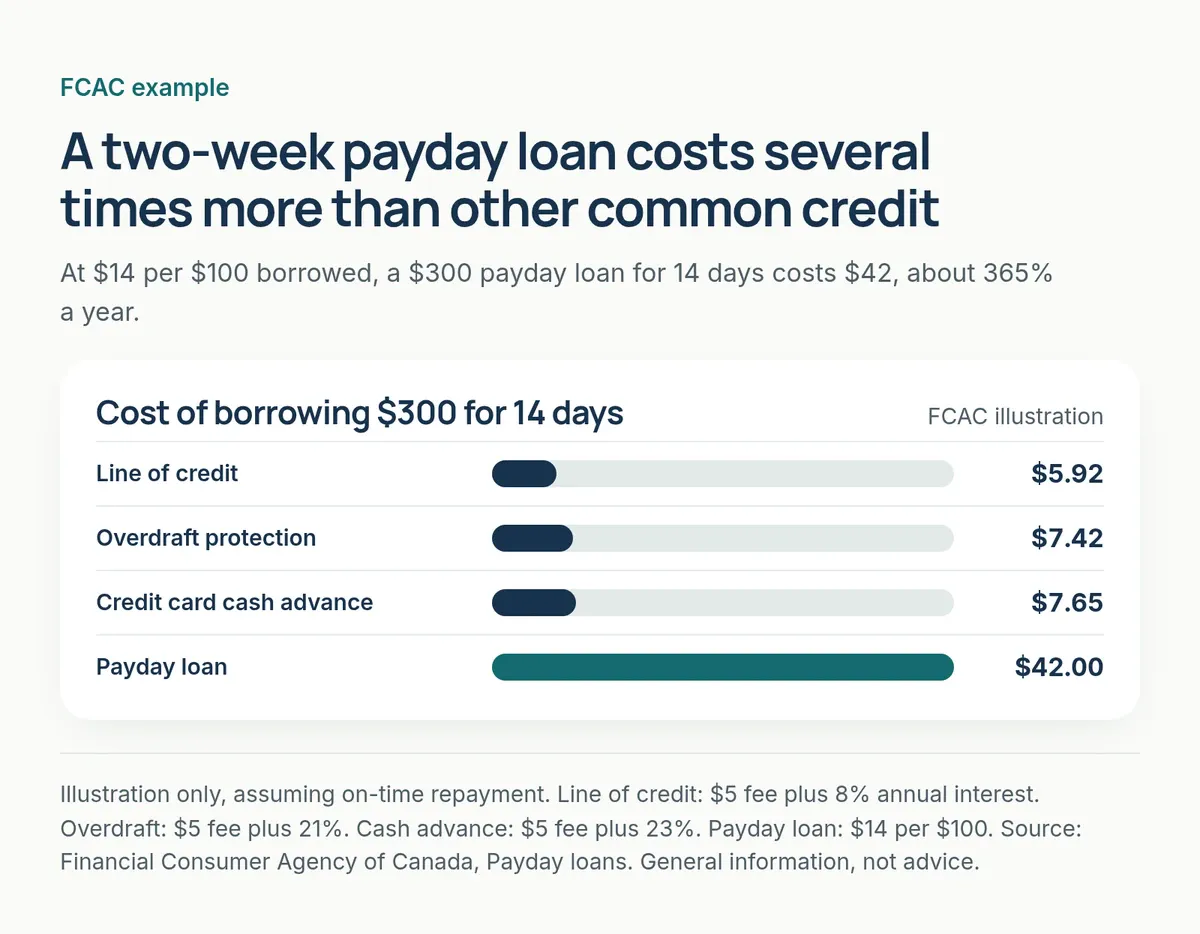
Since January 1, 2025, payday lenders in provinces with payday rules can’t charge more than $14 per $100 borrowed, including all fees. That sounds modest until you see it as an annual rate. FCAC’s example is a $300 loan for 14 days: it costs $42, which FCAC says works out to roughly 365% a year.
FCAC sets that against other common options for the same $300 and 14 days, assuming on-time repayment. A line of credit with a $5 fee and 8% interest costs $5.92. Overdraft protection with a $5 fee and 21% interest costs $7.42. A credit card cash advance with a $5 fee and 23% interest costs $7.65.
Late payment makes it worse. FCAC notes a lender may charge a $20 fee for a dishonoured cheque or a payment that doesn’t go through, your bank may add its own NSF fee, and interest can be charged on what’s still owing. FCAC’s own illustration takes the $300 loan to $362 after one missed payment.
Who uses payday loans?
Not many Canadians, but often the ones with the fewest options. FCAC’s August 2025 report, Understanding Payday Loan Use and Perspectives, draws on its Financial Well-Being Monitor (collected from August 2020 to December 2023) and a 2022 to 2023 survey of payday loan users. About 1.7% of Canadians in the monitor had used a payday loan in the past 12 months. Use was higher among lone parents, renters and people in households earning under $40,000.
The people using them tend to be under real strain. FCAC found 43% of payday loan users said they were struggling a lot, and 90% of that group had no emergency savings or had trouble affording essentials like food. Many also misjudge the price: 26% of surveyed users thought payday loans cost the same as a traditional bank loan, and only 25% saw them as more expensive than other credit. Both surveys predate the 2025 cost cap, so the figures describe the market before that change.
FCAC also points out a catch in its own cost comparison. Cheaper options like a line of credit or overdraft assume you have a bank relationship that offers them, and people with low incomes may be turned down or charged more. That’s the gap where a payday loan often ends up being the option someone can actually get.
How is an employer loan benefit different?
An employer loan benefit is offered through work but run by a separate lender. Here’s how Buffer’s model lines up against a payday loan on the points FCAC and the provinces highlight.
| Payday loan | Buffer Financial (employer loan benefit) | |
|---|---|---|
| Typical amount | Up to $1,500 | Typically $100 to $1,500 |
| Repayment | Up to 62 days, with some or all due on your next payday | Typically 1 to 6 months |
| Cost | Up to $14 per $100 borrowed in provinces with payday rules (about 365% a year on FCAC’s two-week example) | 12% to 18% APR, with no interest for eligible employees who repay in full within 29 days of payout |
| Late or penalty fees | Dishonoured payment fee of up to $20, plus possible interest | No penalties or late fees |
| Credit check | May qualify without a credit check | No hard credit inquiry; underwriting looks at employment, income and bank transaction history |
| Cost to the employer | Not applicable | No setup, subscription or per-employee fees |
A few details on Buffer’s side are worth stating plainly. The interest-free period starts the day the loan is paid out, and it can be used only once. After someone repays a loan in full within 29 days, every later loan is charged the regular APR from day one, and a loan repaid after day 29 is charged interest from the payout day. Approval isn’t guaranteed, and borrowing still creates a repayment obligation.
Employers don’t fund the loans, make credit decisions, carry credit risk or handle repayment and collections. Zero data is shared with employers. Our explainer on who funds the loans and takes the risk goes through that in more detail.
Earned wage access is a different category again. It pays out wages already earned, so the next paycheque is smaller. We cover that comparison in Is earned wage access a good employee benefit?
Are payday loan rules changing?
They may be. In Budget 2026, released November 5, 2026, the federal government announced its intention to amend the payday lending exemption in section 347.1 to extend the minimum repayment period to 42 days, require repayment in instalments and prohibit credit insurance charges on payday loans. The budget points to Alberta as a province that already gives borrowers longer, more flexible repayment.
These are intentions, not law yet. The Criminal Code, current to October 29, 2026, still sets out the $1,500 and 62-day limits.
What should employers look for in a loan benefit?
If you’re comparing providers, a payday loan is a useful benchmark for what to avoid. A few questions help:
- Is the cost stated as an APR? A flat fee per $100 can hide a very high annual rate. Ask for the APR range and how interest works if a loan is repaid late.
- Is repayment spread out? A schedule of instalments over months is easier to manage than a single payment due on the next payday.
- Are there late fees or penalties? Ask for the full list in writing.
- What does the employer actually do? Find out who funds the loans, who makes credit decisions and who handles collections, and what, if anything, you’ll see about individual employees.
- Is it truly optional? Participation should be voluntary, and nobody should feel watched for using it or not.
Our longer list of questions to ask before offering employees emergency loans covers eligibility, data handling and communications.
Where a loan benefit doesn’t fit
A cheaper loan is still a loan. It can help with a one-off cost like a car repair or a dental bill, but it won’t fix a budget that comes up short every month. Someone already juggling several debts needs a credit counsellor or other debt help first. Our employee guide, Will a small loan fix my money problem, or make it worse?, is written to be shared with staff.
A loan benefit also doesn’t replace fair pay, predictable scheduling or quick fixes to payroll errors. Those come first. If your people are reaching for payday loans, offering a lower-cost option is one part of the answer, not all of it. Explore Buffer for your team.
This article is general information, not legal or financial advice. Buffer is not affiliated with or endorsed by the Financial Consumer Agency of Canada or Consumer Protection BC.
Questions and answers
How much does a payday loan cost in Canada?
In provinces with payday rules, lenders can’t charge more than $14 per $100 borrowed, including fees, since January 1, 2025. The Financial Consumer Agency of Canada’s example is a $300 loan for 14 days, which costs $42, or roughly 365% a year. A missed payment can add a dishonoured payment fee of up to $20 and interest.
Is an employer loan benefit the same as a payday loan?
No. A payday loan is a short-term, high-cost loan that’s usually due around your next payday. Buffer Financial’s employer loan benefit is a voluntary personal loan, typically $100 to $1,500, with an APR of 12% to 18% and repayment over 1 to 6 months. It isn’t a payday loan, a payroll loan or a wage advance, and approval isn’t guaranteed.
Does offering a loan benefit cost the employer anything?
With Buffer, employers pay no setup, subscription or per-employee fees. They don’t fund the loans, make credit decisions, carry credit risk or handle repayment and collections. Borrowing still creates a repayment obligation for the employee.
Are the payday loan rules in Canada changing?
Budget 2026, released November 5, 2026, announced the federal government’s intention to amend the Criminal Code’s payday lending exemption to set a 42-day minimum repayment period, require instalments and prohibit credit insurance charges. These are intentions, not law yet.
Sources and references
- Payday loans · Financial Consumer Agency of Canada
- Understanding Payday Loan Use and Perspectives · Financial Consumer Agency of Canada
- Payday loans · Consumer Protection BC
- Criminal Code, section 347: Criminal interest rate · Justice Laws Website
- Criminal Code, section 347.1: Payday loans · Justice Laws Website
- Budget 2026, Chapter 3 · Department of Finance Canada
Product facts in this article were supplied by Buffer Financial Inc. This article is general information, not personal financial advice or an offer of credit.
Follow Buffer
Add Buffer as a preferred source and Google will show you more of our articles.