

Contents
Key takeaways
- ZayZoon is earned wage access: employees get part of the pay they’ve already earned before payday, and the payout plus any fee comes off the next paycheque. ZayZoon says it isn’t a loan.
- As of November 16, 2026, ZayZoon’s Canadian pages list up to $200 per payout, one payout a day, up to 50% of net wages to a maximum of $1,000 per pay cycle, and a $4 CAD fee per Interac e-Transfer payout, with no interest or late fees.
- The main alternatives are another earned wage access provider, a pay advance from your company, a structured small loan benefit, and support that isn’t borrowing.
- Buffer is a structured personal loan offered as a voluntary benefit, typically $100 to $1,500 CAD over 1 to 6 months at 12% to 18% APR. Approval isn’t guaranteed, and borrowing creates a repayment obligation.
- Start with the problem: earned wage access suits short gaps before payday, while larger bills or a preference to keep repayment out of payroll point to comparing a structured loan benefit.
If you’re searching for ZayZoon alternatives, you’re probably weighing an earned wage access program for your team, or you already offer one and want to know what else is out there. ZayZoon is an earned wage access provider with a Canadian office in Calgary, Canadian pricing and its own Canadian terms of service.
The most useful question isn’t which product is best in general. It’s what kind of shortfall your employees actually face, and what happens to their next paycheque after they get help. Here’s how ZayZoon works in Canada, based on its own public pages as of November 16, 2026, the main alternatives, and how a structured small loan benefit compares.
How does ZayZoon work in Canada?
ZayZoon partners with an employer and its payroll provider so employees can access part of their pay before the regular payday. Its Canadian help centre says ZayZoon is not a loan. It uses historical payroll data to estimate how much each employee can access, then tells payroll what was taken so the repayment comes out of the next paycheque or paycheques.
ZayZoon sets the limits. Each payout is capped at $200, with one payout a day, according to its help article on access limits, which also says the limits can’t be waived, even in an emergency. Per pay cycle, employees can take up to 50% of their net wages, to a maximum of $1,000, according to ZayZoon’s employer help centre.
For Canadian employees, the fee is a flat $4 CAD per payout sent by Interac e-Transfer, which ZayZoon says usually arrives within minutes. Payouts to instant gift cards have no fee. There’s no interest, and ZayZoon says employees never pay a late fee. Its Canadian terms of service add that a payout can be fee-free in some cases, for example when the employer has chosen to pay for certain usage.
Repayment is automatic. The payout plus any fee comes off the next pay, and ZayZoon’s repayment article says repayments can’t be skipped, delayed or changed. If one paycheque doesn’t cover it, the rest is deducted from the next eligible one, and new payouts are paused while a balance over $25 is outstanding. The Canadian terms describe payouts as nonrecourse and say ZayZoon won’t run credit checks, won’t report repayment history to a credit bureau and won’t use third-party debt collection.
For employers, ZayZoon’s Canadian employer page says it doesn’t cost a cent unless you want it to. Paid options exist, though their pricing isn’t published, and you can choose to cover part of employees’ transaction fees. It needs an integration with your payroll provider, and its Canadian site says it works with more than 300 payroll partners. ZayZoon also offers perks, financial education and recognition tools.
Why might you look for an alternative?
None of this makes ZayZoon a poor choice. For a gap of a few days, moving earned pay forward can be exactly what someone needs, and a flat fee is easy to understand.
Alternatives usually come up when the need doesn’t fit the model. Three things tend to drive the search.
The size of the emergency. Here’s a hypothetical example. An employee’s car needs an $800 repair partway through a pay period. Even if enough earned pay is available, a $200 cap and one payout a day mean four payouts over four days. By Interac e-Transfer, that’s four $4 fees, or $16. If all four fall in the same pay period, $816 comes out of the next paycheque. A bill over $1,000 can’t be covered within one pay cycle at all.
The next paycheque. Earned wage access moves money forward rather than adding to it. If the budget was already tight, a smaller paycheque can leave the next pay period short too. We looked at this in more detail in Is earned wage access a good employee benefit?
Your payroll’s role. Every payout is recovered through your payroll. Some employers are comfortable with that. Others would rather keep repayment out of payroll entirely.
What are the alternatives to ZayZoon?
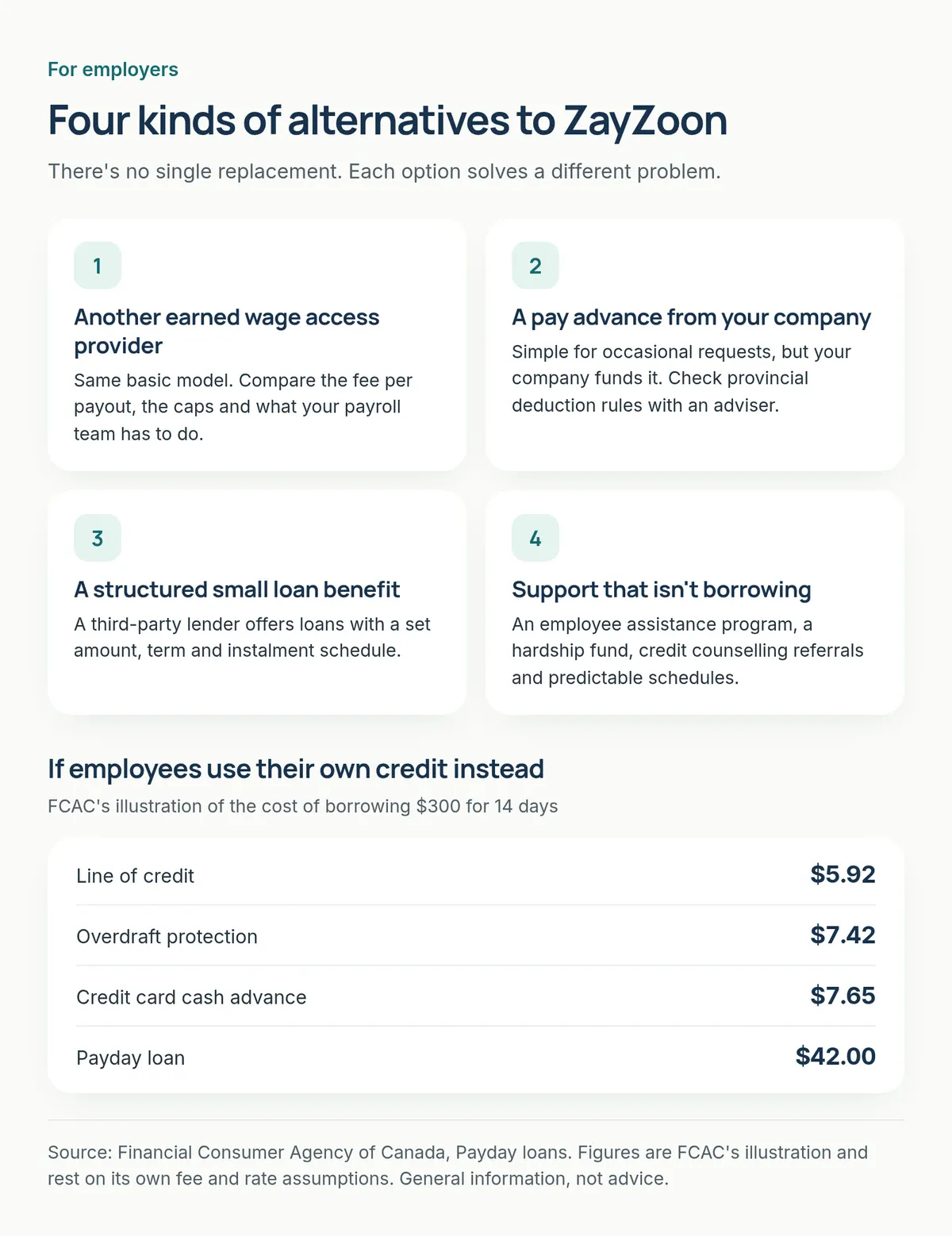
There’s no single replacement, because the options solve different problems.
- Another earned wage access provider. Several operate in Canada, some as stand-alone apps and some built into payroll platforms. The model is broadly the same, so compare the fee per payout, the caps, how much is available early in a pay period and what your payroll team has to do.
- A pay advance from your company. The Financial Consumer Agency of Canada (FCAC) lists asking your employer for a pay advance as one option in a financial emergency. It’s simple for occasional requests, but your company funds it, and recovering it from pay means checking your province’s rules on deductions with a qualified adviser.
- A structured small loan benefit. A third-party lender offers loans through your workplace, with a set amount, term and instalment schedule. Buffer Financial works this way, and the next section compares it with ZayZoon.
- Support that isn’t borrowing. An employee assistance program, a hardship fund, a referral to an accredited credit counsellor and predictable scheduling all ease money stress without adding a repayment.
Employees without a workplace option often turn to their own credit, and the choice matters. In FCAC’s illustration of borrowing $300 for 14 days, the cost is $5.92 on a line of credit, $7.42 with overdraft protection, $7.65 as a credit card cash advance and $42 as a payday loan. Those figures rest on FCAC’s own fee and rate assumptions.
How does Buffer compare with ZayZoon?
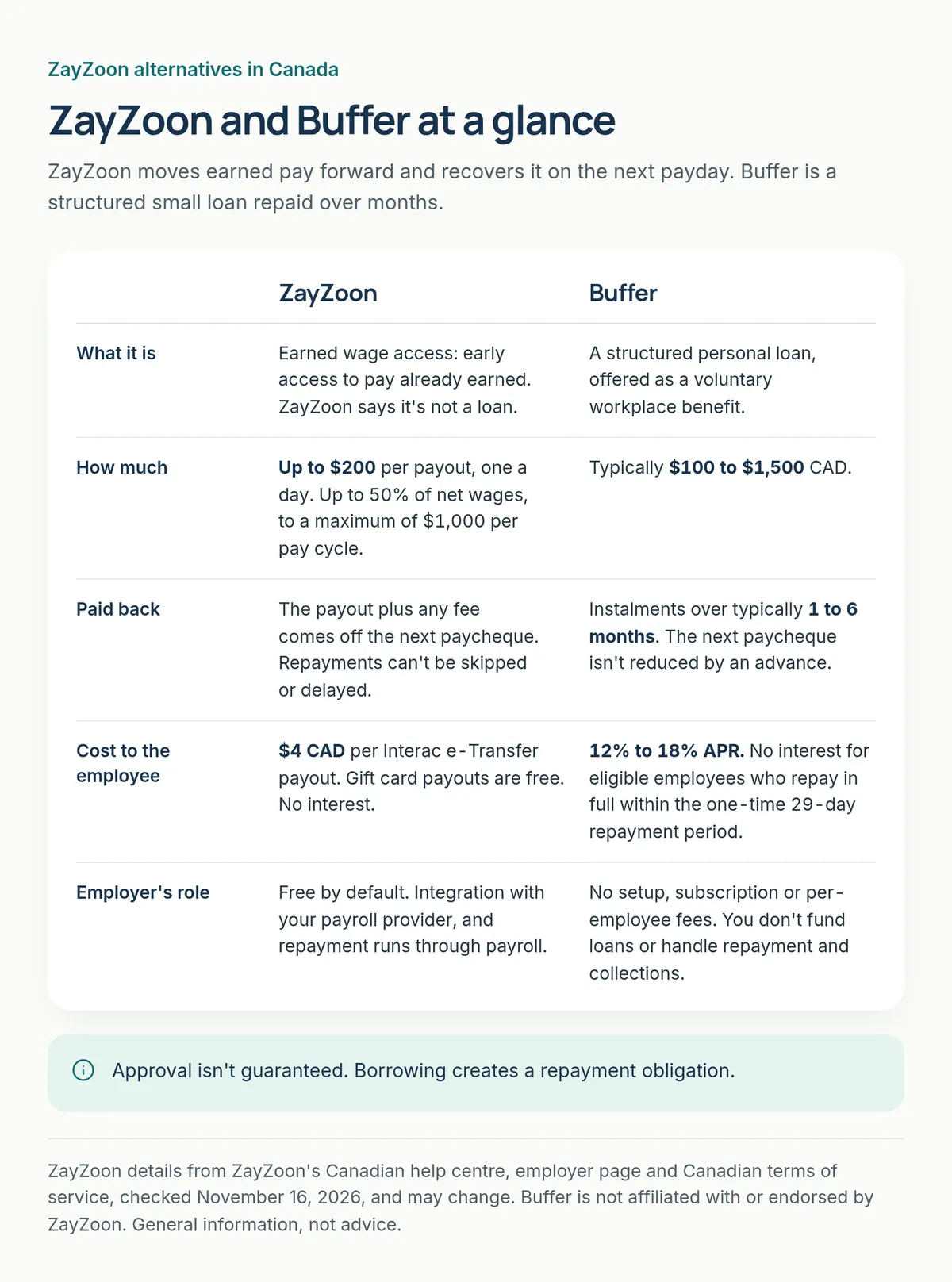
Buffer isn’t earned wage access. It provides emergency fund support through a voluntary employee financial wellness benefit. Its core product is a structured personal loan, typically $100 to $1,500 CAD, with repayment terms of 1 to 6 months and an APR of 12% to 18%. Eligible employees who repay in full within the one-time 29-day repayment period pay no interest. There are no penalties or late fees. Underwriting considers employment, income and bank transaction history, not only traditional credit scores, and there’s no hard credit inquiry. Approval isn’t guaranteed, and borrowing creates a repayment obligation.
The clearest differences are size and term. ZayZoon advances up to $200 at a time from pay already earned and recovers it on the next payday. Buffer’s loans are typically larger and repaid over months, so the next paycheque isn’t reduced by an advance, though instalments are still due. The employer’s role differs too. With Buffer, you don’t fund loans, make credit decisions, carry credit risk or handle repayment and collections. There are no setup, subscription or per-employee fees, although ZayZoon’s standard option is also free to employers. If Buffer costs employers nothing, who carries the risk? explains how that split works.
Costs work differently, too. ZayZoon charges a flat fee per payout, whatever the amount, and no interest. A loan charges interest at its APR unless the 29-day condition is met. How to figure out what a small loan will really cost walks through how APR and term add up.
ZayZoon details below come from ZayZoon’s own Canadian pages, checked on November 16, 2026, and may change. Payday loan details come from FCAC’s payday loans page.
| ZayZoon | Buffer | Payday loan | |
|---|---|---|---|
| What it is | Earned wage access, which ZayZoon says is not a loan | A structured personal loan offered as a voluntary workplace benefit | A short-term loan with high fees |
| How much | Up to $200 per payout, one a day, and up to 50% of net wages to a maximum of $1,000 per pay cycle | Typically $100 to $1,500 CAD | Up to $1,500 |
| Next paycheque | Payout plus any fee deducted on the next pay date | Not reduced by an advance, since it isn’t drawn from earned pay. Instalments are still due | Some or all is due on your next paycheque |
| Cost to the employee | $4 CAD per Interac e-Transfer payout, gift card payouts free, no interest | 12% to 18% APR, with no interest for eligible employees who repay in full within the one-time 29-day repayment period | Up to $14 per $100 borrowed where provinces regulate it |
| Cost to the employer | Free by default; paid options exist (pricing not published); you can cover part of employees’ fees | No setup, subscription or per-employee fees | None; the employer isn’t involved |
| Payroll’s role | Integration with your payroll provider; repayments are deducted through payroll | Employers don’t handle repayment or collections | None |
| Credit check | None, under its Canadian terms | No hard credit inquiry | You may qualify without one |
| Credit bureaus | Doesn’t report repayment history to a credit bureau | Buffer reports loans to credit bureaus, and if borrowers don’t pay their instalments, Buffer will report it to credit bureaus. | A collection agency may be involved, and this may appear on your credit report |
| Repayment term | Next pay date; can’t be skipped, delayed or changed | Typically 1 to 6 months | Usually weeks, up to 62 days |
| Late fees | None | No penalties or late fees | More fees and interest if late, plus up to $20 for a dishonoured cheque where regulated |
Which option fits your team?
Start with the problem rather than the product. If most requests are small and a few days before payday, an earned wage access program like ZayZoon may fit. If employees face bills bigger than a few days’ pay, or you’d rather keep repayment out of payroll, a structured small loan benefit is worth comparing. Either way, ask the same questions about cost, limits, data and what happens when someone leaves. Our list of what employers should ask before offering emergency loans is a good place to start.
Neither option replaces fair pay, predictable hours or support that isn’t borrowing. Explore Buffer for your team.
This article is general information, not legal, payroll or financial advice. Buffer is not affiliated with or endorsed by ZayZoon.
Questions and answers
Is ZayZoon a loan?
ZayZoon says it isn’t. It describes its service as access to pay you’ve already earned, and its Canadian terms of service describe payouts as nonrecourse. Whether a product counts as credit under a particular law is a question for a qualified adviser.
How much does ZayZoon cost employees in Canada?
As of November 16, 2026, ZayZoon’s Canadian help centre lists a flat $4 CAD fee per payout sent by Interac e-Transfer. Payouts to instant gift cards have no fee, and there’s no interest or late fee. An employer can choose to cover part of employees’ fees.
How much money can I get from ZayZoon?
ZayZoon caps each payout at $200 and allows one payout a day. Per pay cycle, employees can access up to 50% of their net wages, to a maximum of $1,000. ZayZoon says these limits can’t be waived, even in an emergency.
Does ZayZoon check your credit?
ZayZoon’s Canadian terms of service say it won’t run credit checks, won’t report repayment history to a credit bureau and won’t use third-party debt collection.
What happens to my next paycheque after a ZayZoon payout?
The payout plus any fee is deducted from your next pay through your employer’s payroll. ZayZoon says repayments can’t be skipped, delayed or changed, and if one paycheque doesn’t cover it, the rest comes off the next eligible one.
Is Buffer an earned wage access provider?
No. Buffer provides emergency fund support through a voluntary employee financial wellness benefit. Its core product is a structured personal loan, typically $100 to $1,500 CAD, with 1 to 6 month terms and a 12% to 18% APR. Eligible employees who repay in full within the one-time 29-day repayment period pay no interest. Approval isn’t guaranteed, and borrowing creates a repayment obligation.
Does a ZayZoon alternative cost the employer anything?
It depends on the option. ZayZoon’s standard option is free to employers, with paid options whose pricing isn’t published. Buffer has no setup, subscription or per-employee fees, and employers don’t fund loans, make credit decisions, carry credit risk or handle repayment. A company pay advance is funded by the company itself.
What's cheaper than a payday loan?
In FCAC’s illustration of borrowing $300 for 14 days, a payday loan costs $42, compared with $7.65 for a credit card cash advance, $7.42 with overdraft protection and $5.92 on a line of credit. FCAC also suggests asking for more time to pay bills or asking your employer for a pay advance.
Sources and references
- What is ZayZoon? (Canada) · ZayZoon Help Center
- How Much Does ZayZoon Cost? (Canada) · ZayZoon Help Center
- What are the different wallets? (Canada) · ZayZoon Help Center
- How much money can I access with ZayZoon? · ZayZoon Help Center
- What is the daily limit for payouts? What is the limit per pay cycle? · ZayZoon Employer Help Center
- How do ZayZoon repayments work? · ZayZoon Help Center
- ZayZoon Canada Terms of Service · ZayZoon
- ZayZoon for Canadian Employers · ZayZoon
- ZayZoon Canada home page · ZayZoon
- Payday loans · Financial Consumer Agency of Canada
Product facts in this article were supplied by Buffer Financial Inc. This article is general information, not personal financial advice or an offer of credit.
Follow Buffer
Add Buffer as a preferred source and Google will show you more of our articles.